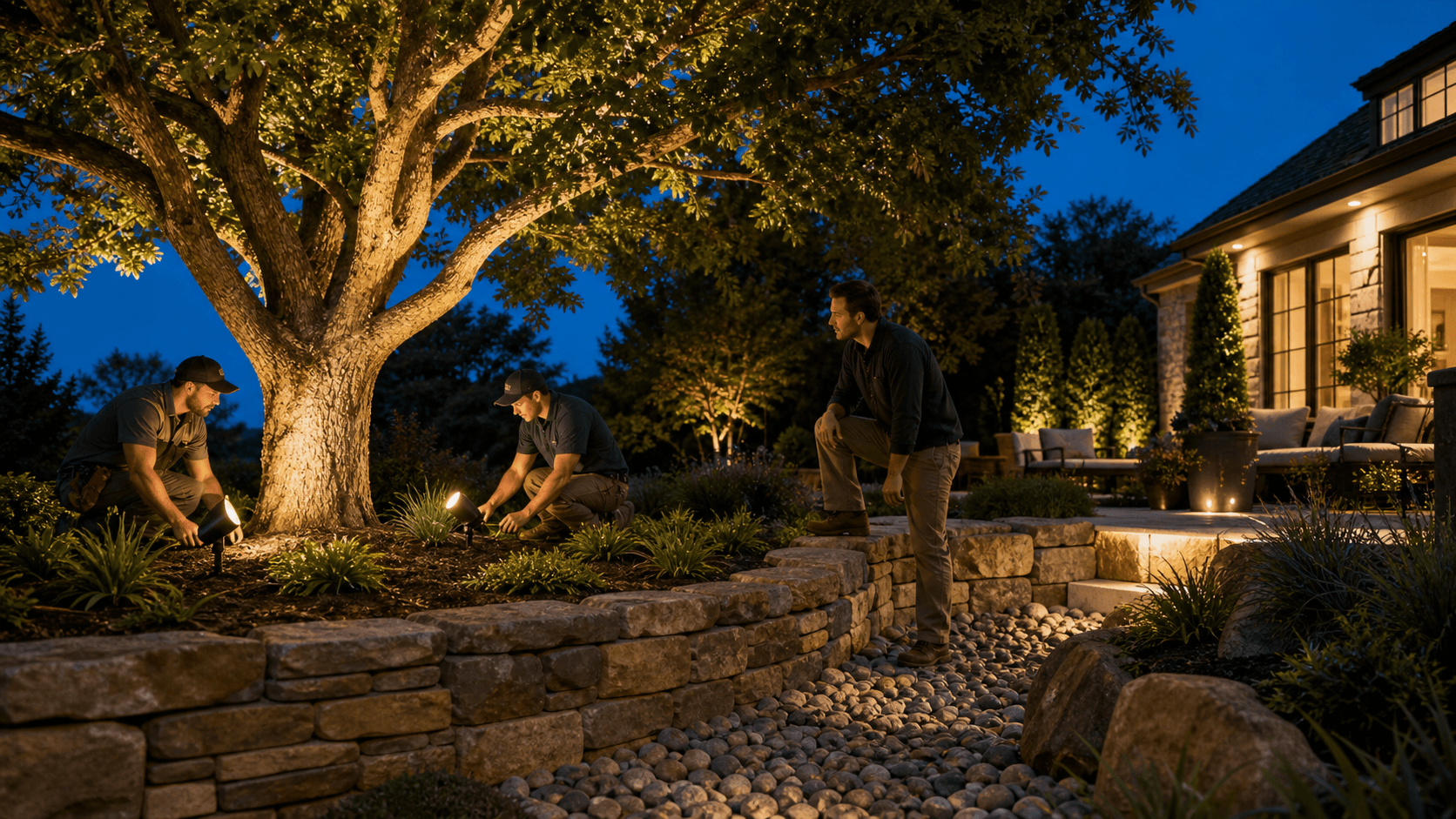
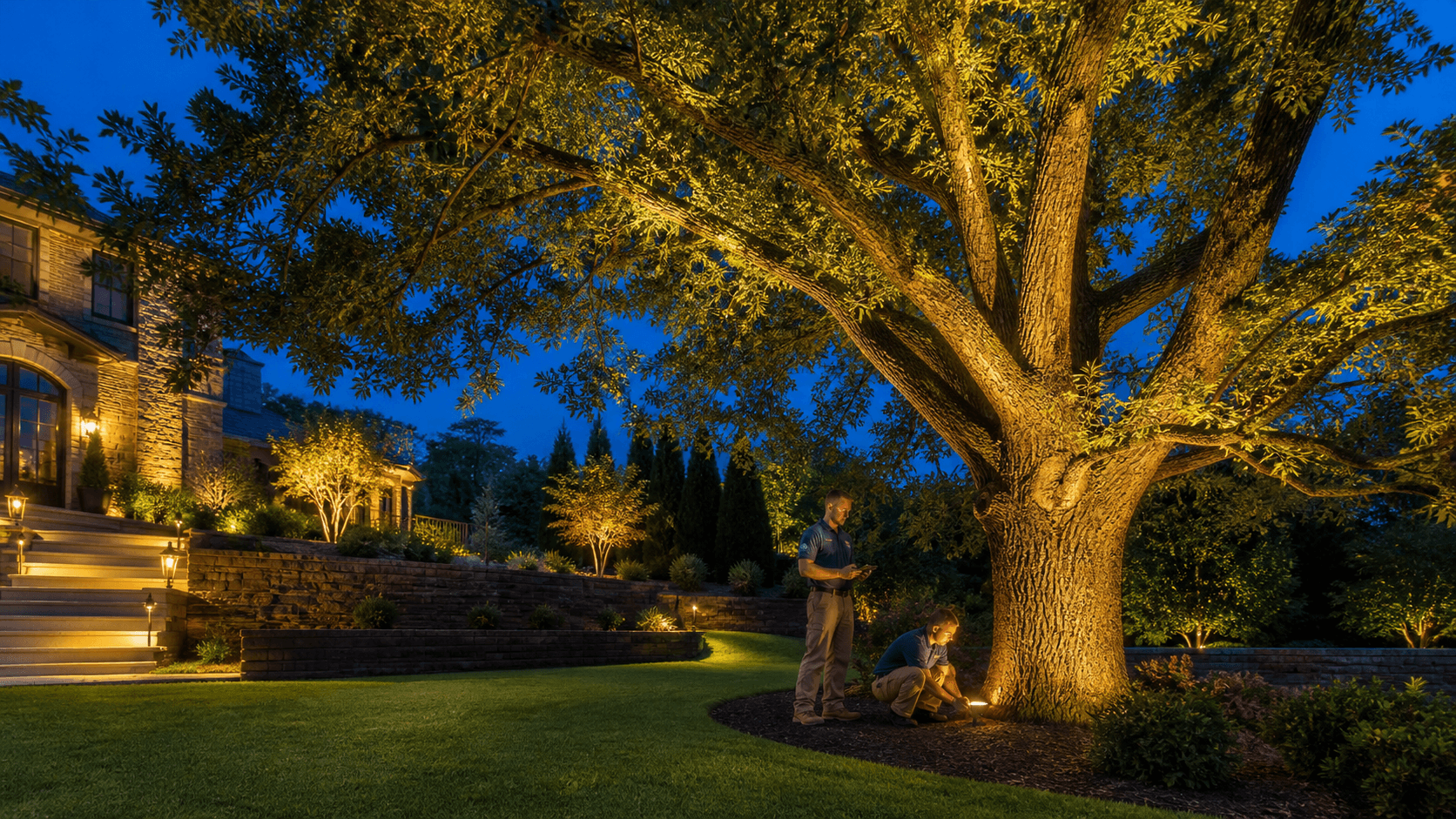
Designing Estate Walkway Lighting in Birmingham's Clay Hills
Good walkway lighting on a big Birmingham property is not about throwing a few path lights along the edge and calling it done. In our clay hills, it has to work with slope, water, and structure, or it won't stay safe or attractive for very long. When we talk about Landscape Lighting in Birmingham, we're really talking about how light, grading, and drainage all work together.
On large homes with long drives and sloped walks, the lighting plan needs to protect guests, protect the hardscape, and still keep the property looking calm and refined at night. That takes some planning before a single wire goes in the ground. Let's talk through how we approach that in Central Alabama's red clay and rolling terrain.
Why Birmingham's Clay Hills Change Walkway Lighting
Estate properties around the Greater Birmingham area rarely sit on flat, gentle ground. Walks and drives often:
- Climb from street to house, sometimes with sharp grades
- Break across the slope, where water wants to cut across the path
- Weave between walls, steps, planting beds, and lawns
In this setting, good lighting is as much about structure as it is about fixtures. Clay soils hold water and move with the seasons, which means anything tied to the ground, including lighting, wants to move too. If we ignore that, lights start to lean, wires get stressed, and glare shows up where we don't want it.
So when we plan Landscape Lighting in Birmingham's clay hills, we start by thinking like builders. We look at soil behavior, base preparation, drainage, and structural support before we even pick a fixture style.
Reading the Site: Clay, Slopes, and How People Move
On Alabama red clay, water doesn't sink fast like it does in sand. It tends to sit, swell the soil, then dry out and shrink. That affects:
- How deep we run conduit so it's protected from heaving
- Where we can safely mount fixtures without long-term tilt
- How we protect junctions and wire splices from standing water
Slopes and cross-slope grading around steps and walks shape how safe the route feels at night. Steep grades and turns can create surprise shadows, and poorly placed fixtures can blind someone walking up or down.
We pay attention to:
- Whether a run is uphill, downhill, or across the hill
- How water wants to move across or along the walk
- Where a guest's eye level will be as they climb or descend
A key part of our process is walking the property with the owner right at dusk. That's when we can see:
- Dark pockets that feel unsafe
- Trip points, like uneven step edges and landings
- Important sightlines from the house, the drive, and main gathering areas
This walk-through sets the priorities long before a shovel hits the ground.
Planning Walkway Lighting as One Integrated System
Estate walkways don't live alone. They tie into drives, walls, patios, steps, planting beds, irrigation, and structures. If lighting is planned as an afterthought, it usually fights with:
- Irrigation lines
- Drainage pipes and inlets
- Footings, walls, and step foundations
An integrated design-build approach, one team, one plan, one standard, keeps everything coordinated. When hardscape, irrigation, drainage, and Landscape Lighting are drawn together, we can:
- Reserve space for conduit in footings, walls, and step runs
- Align irrigation lines and drainage so they don't cross or crush wiring
- Size transformer locations early so they're accessible but discreet
Early planning lets us cast conduit under walks, behind retaining walls, and under stairs before concrete, pavers, or stone go in. That way, we're not cutting into finished work later to add one more light down the hill or across the drive.
Structural Choices Behind a Clean, Safe Glow
Walkway lighting that looks simple on the surface usually has a lot going on underneath. On Birmingham clay, we put a lot of attention into what you never see:
- Base preparation and compaction at walk edges and landings so fixtures don't lean as the soil swells and shrinks
- Proper depth and bedding for conduit so soil movement doesn't pinch or expose it
- Solid mounting points tied into hardscape, not just pushed into soft soil
Fixtures need to stand up to mowers, foot traffic, and ground movement. That often means:
- Using sleeves set in concrete for path lights near turf
- Masonry anchors for step lights and wall-mounted fixtures
- Integrated mounting blocks cast or set into the hardscape itself
On the electrical side, we think long term. That includes:
- Wiring routes that allow for loops and redundancy, not dead-end runs everywhere
- Junction box locations that are serviceable but not in the way
- Transformer sizing that allows for voltage balance, clean dimming, and future expansion along the drive or into side yards
This is where an engineering-first mindset pays off. If the structure and wiring are sound, the lighting can grow with the property instead of fighting it.
Controlling Light, Glare, and Water on Sloped Terrain
Birmingham's hills can create tough lighting angles. You might have guests driving up a steep driveway while others walk down steps to a lower patio. If fixtures aren't shielded and aimed correctly, someone ends up with light directly in their eyes.
We manage that by:
- Using more downlighting from trees or structures where possible, instead of only path lights
- Adding shields and louvers to control glare on steep grades
- Choosing beam spreads that wash the tread but don't blast across it
Color temperature matters too. On wooded, hilly lots, a slightly warmer white often feels more natural against brick, stone, and mature plantings, and it stays comfortable as leaves drop and more bark and structure show.
Water control is just as important as light control. Around fixtures, steps, and landings, we plan:
- Surface grading that pulls water off treads toward drains or grass
- Drainage outlets that don't dump directly where fixtures sit
- Fixture locations clear of low pockets where water and debris collect
That way, we're not lighting a step that stays slick after every storm, and we're not soaking connections every time we get a winter rain.
Seasonal Timing, Maintenance, and the Value of Design-Build
Shorter days and heavier evening traffic in the fall often reveal where walkway lighting is missing or weak. It's also when leaf drop and wet clay start to show how water really moves on your property. Planning work around these seasons helps us account for:
- How leaves will cover fixtures near oaks or maples
- How winter rains will track along walks and drives
- How spring growth might block a beam or hide a step edge
Realistic maintenance on an estate walkway system includes:
- Cleaning lenses and checking aim a few times a year
- Checking connections and junctions after big weather swings
- Trimming back shrubs and groundcovers that creep into the light pattern
When the system is engineered correctly, that maintenance is simple and predictable, not a constant struggle.
Keeping hardscape, drainage, irrigation, plantings, and Landscape Lighting under one design-build team avoids the common problems of wires cut by a later contractor, blocked conduit paths, uneven grades around fixtures, or mismatched finishes. At Wood-Palmer Outdoor Creations, our 75 years of combined leadership experience, plus our engineering-focused approach to Alabama's clay soil, show up in the details: where step edges fall, how fixtures line up with sightlines, and how water clears a landing after a storm.
Walking your own property with that same builder-minded eye is the best starting point. Notice the slopes, the clay, the way water moves, and how you and your guests actually travel after dark. That perspective is what leads to walkway lighting that feels natural, safe, and steady year after year in Birmingham's clay hills.
If you're ready to look at your walkways with that kind of structural eye, let's talk about your property at (205) 305-7780, email info@woodpalmer.com, or reach out through the contact form at woodpalmer.com/contact.
Get Started With Your Project Today
Transform your outdoor space with custom lighting designed to highlight your home's best features and improve safety after dark. Explore how our landscape lighting in Birmingham solutions can bring out the character of your property in every season. At Wood-Palmer Outdoor Creations, we listen to your goals, walk your property with you, and create a tailored design that fits your style and budget. Ready to talk details or schedule a consultation? Simply contact us and we will help you get started.