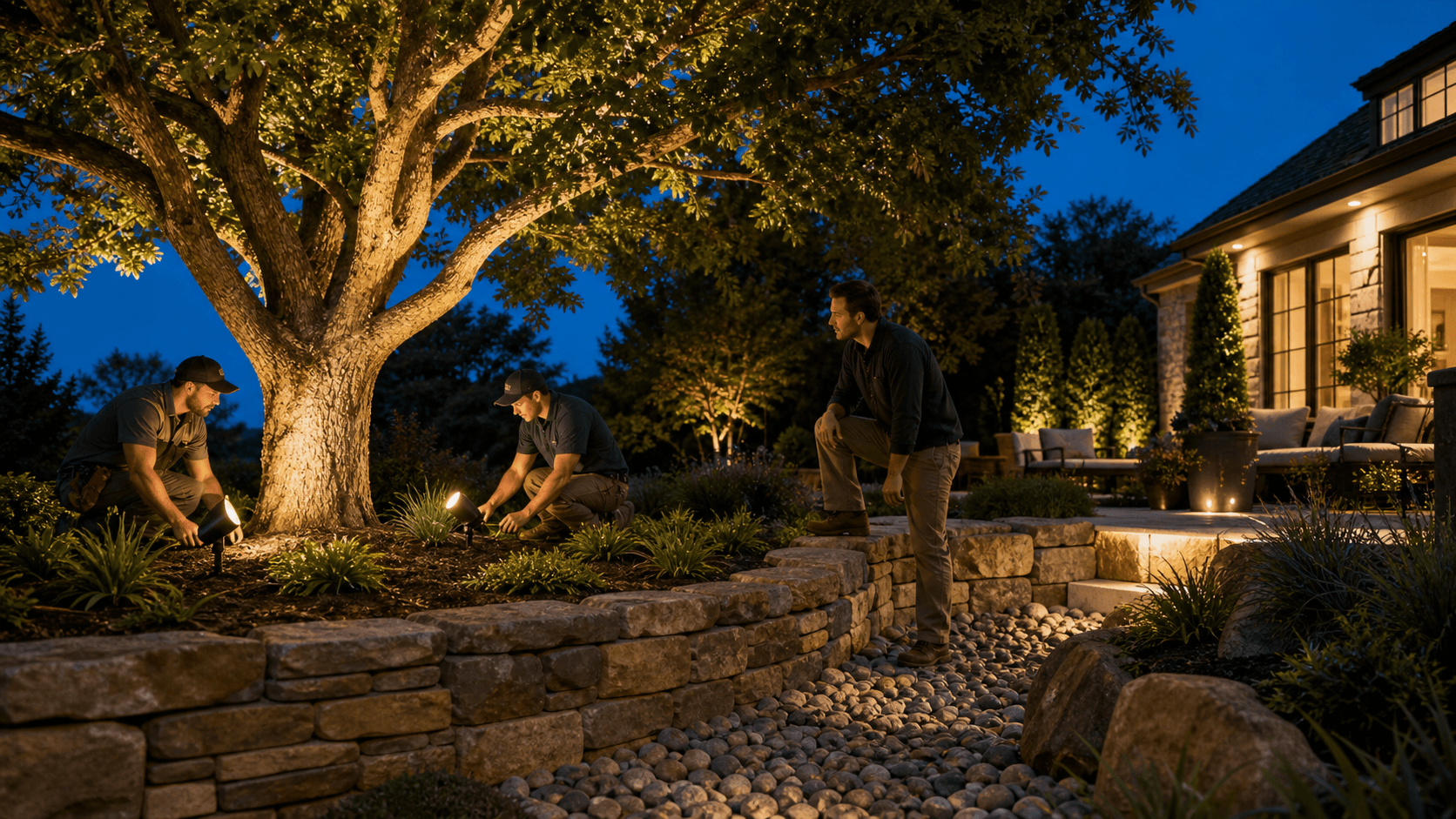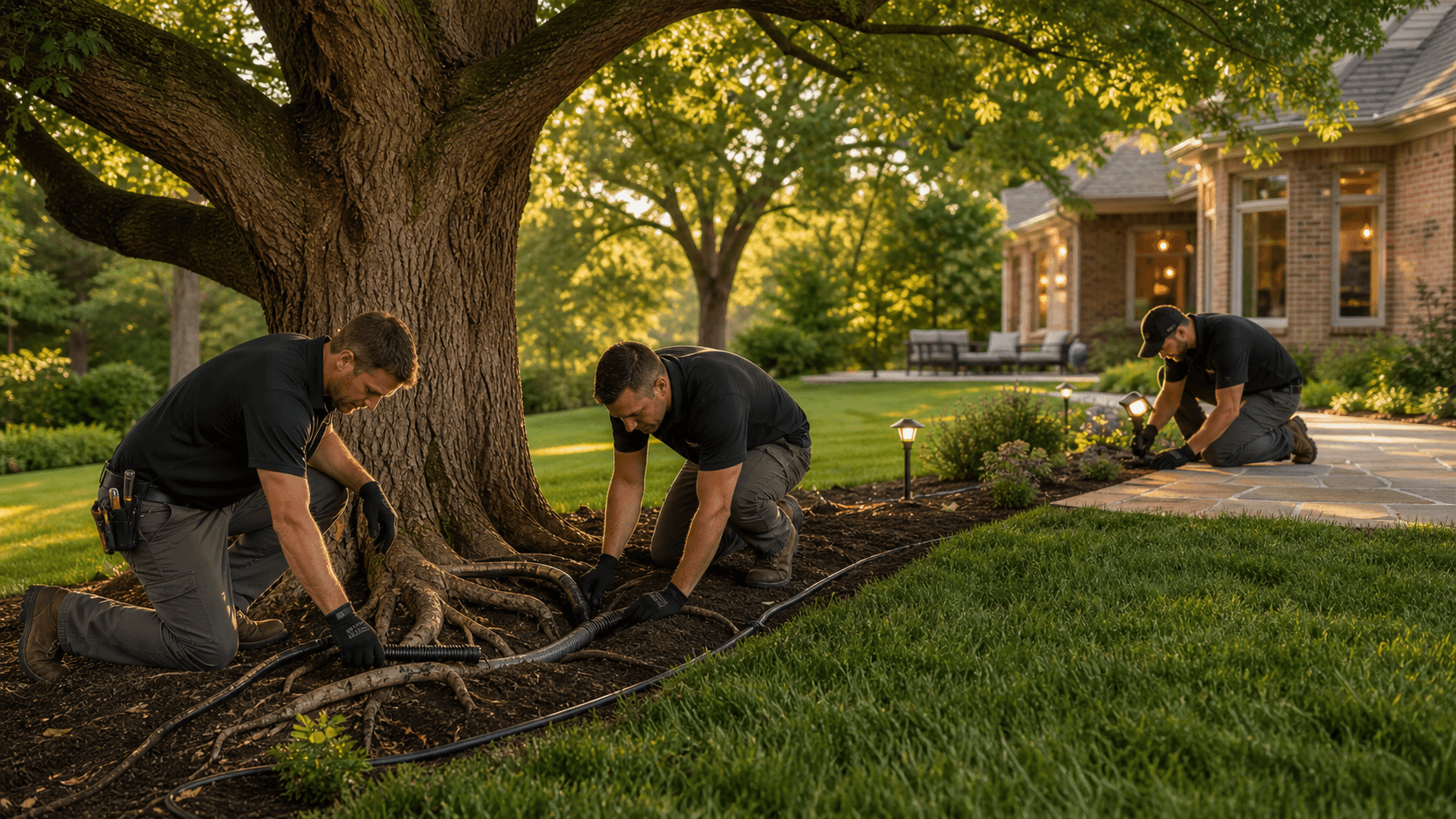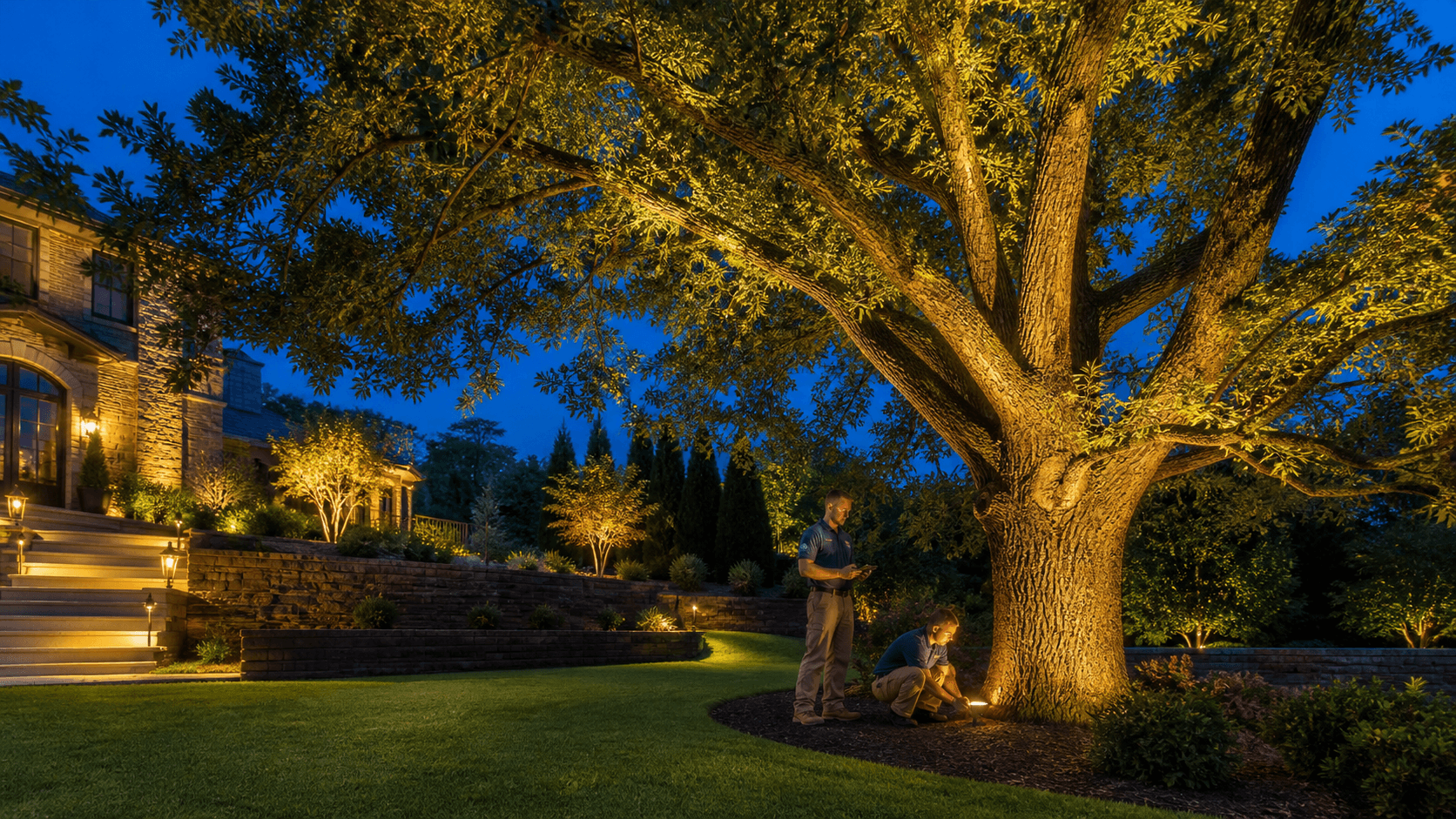
Estate Tree Canopies That Work After Dark
Tree canopies are often the strongest features on a Birmingham estate. Large oaks, pines, and hardwoods frame the drive, shade outdoor rooms, and set the tone for the whole property. When the sun drops, those same trees can disappear into darkness and leave patios, parking areas, and walks in shadow.
Integrated tree lighting in Birmingham is not just about prettier branches at night. It is a structural decision that affects safety, long-term tree health, and how every other part of your outdoor build performs. If it is not engineered and built correctly, it can work against your grading, your hardscape, and even your irrigation.
At Wood-Palmer Outdoor Creations, we treat landscape lighting as part of the overall system, not as a decorative add-on at the end. With 75 years of combined leadership experience, our team, including ownership, stays involved in field decisions around large canopies because those choices impact the whole property. Here is how we think through, engineer, and build tree-focused lighting systems that work with Central Alabama's terrain and climate instead of fighting them.
Why Tree Lighting in Birmingham Demands Engineering
Central Alabama estates tend to share a few traits: heavy red clay, rolling grades, rock pockets, and deep root systems in older trees. Those conditions are not just a backdrop. They change how we plan and install every run of wire and every fixture that serves your canopy.
Tree lighting in Birmingham becomes a structural issue because of things like:
- Conduit routing around root zones instead of cutting through them
- Drainage around tree bases so fixtures are not sitting in standing water
- Voltage drop across long wire runs on sloped sites
- Soil movement where clay swells when wet and tightens when dry
We design tree lighting circuits with the same mindset we use for hardscape and irrigation. That means:
- Load calculations so transformers are correctly sized
- Wire sizing to keep voltage consistent at the farthest fixtures
- Transformer placement where they stay dry, accessible, and out of sight
- Service access so repairs do not require tearing up finished surfaces
Poor planning can lead to root damage, fixtures that tilt after a storm, and hot spots where some trees are blown out while others are barely lit. Thoughtful engineering on the front end protects the trees, the wiring, and the structural integrity of walls, patios, and drives that sit nearby.
Designing the Canopy Lighting Plan as One System
When one team is responsible for grading, hardscape, irrigation, and landscape lighting, we can design tree lighting as part of a single, coordinated plan. That prevents the canopy lighting from fighting with drainage, structures, or underground utilities.
We usually start at the property edges and look inward. From there we study sightlines from key spots:
- Main house windows and porches
- Arrival sequence along the drive and motor court
- Pool decks and outdoor rooms
- Secondary structures like pavilions or guest spaces
Only after that do we choose fixture locations. We line up fixture placement with grading and drainage so:
- Up-lights are above expected water lines, not inside low pockets
- Lights do not sit where mulch will bury them every season
- Swales, French drains, and catch basins stay clear
We also make sure canopy lighting ties into other lighting elements so you are not staring at bright treetops with a dark void below. Steps, retaining walls, walkways, and structures get their own layers so the property reads as one night environment instead of a collection of disconnected bright spots.
Owner involvement matters here. Final aiming and light levels are often reviewed on-site after dark, with someone from our leadership team present, to confirm that balance across the whole estate.
Structurally Sound Installation Around Mature Trees
Installing around large, established trees takes care and planning. We respect the tree's root flare and avoid choking it with soil or concrete. Base preparation around each fixture is built to hold grade and stay stable through storms and years of maintenance.
Key installation decisions include:
- Fixture placement set back from the trunk, to respect roots and bark
- Anchoring methods that stand up to mowing and edging
- Proper burial depth and routing for wiring, so it is protected but serviceable
In Birmingham's climate, summer storms and saturated ground can shift soil and wash out poorly set fixtures. That is why we use protected conduit when crossing from lawn to bed and sleeves under hardscape whenever wire needs to pass beneath walks, drives, or walls.
Serviceability is another structural concern. We plan access points, junction locations, and transformer placement so future work on bulbs, fixtures, or wiring does not mean cutting into patios or pulling out plantings. The goal is a system that keeps its aim, drains correctly, and still throws clean, consistent light on the canopy many years from now.
Balancing Drama, Glare Control, and Tree Health
Big canopy trees give you a lot of visual power at night, but without control, they can also create glare and strain on the trees themselves. In Birmingham neighborhoods where estates sit relatively close together, we aim to keep light on your trees, not in a neighbor's bedroom window.
We balance drama and control through:
- Shielding and glare guards where fixtures sit near drives or sidewalks
- Careful aiming so beams stay on bark and foliage instead of spilling outward
- Beam spread selection that matches tree height and width
Rather than blasting every tree on the property, we often use layered lighting:
- Subtle trunk accents to anchor the tree visually
- Mid-canopy washes to show structure and depth
- Selective highlights on key branches or groups of limbs
Tree health always stays in the conversation. We pay attention to heat output, fixture setback from bark, and avoiding a single concentrated beam sitting in one spot year after year. As growth changes the canopy, we plan for adjustments through dimming, zoning, and the ability to re-aim or re-balance specific trees or zones.
As evenings get cooler and sunsets come earlier, those decisions make the difference between a harsh, over-lit yard and a comfortable backdrop for gatherings, football nights, or quiet time on the patio.
Integrating Tree Lighting with Hardscape and Structures
Tree canopies rarely stand alone. Patios, pool decks, drives, retaining walls, and outdoor structures all sit in the same field of view. For the property to feel right at night, all of those elements must be coordinated with the canopy lighting.
We tie wiring and fixture placement into the structural plan for:
- Patios and pool decks, using joints and sleeves for protected crossings
- Retaining walls and steps, aligning fixture cutouts and conduits with wall design
- Drives and motor courts, planning crossings before concrete or pavers go in
Vertical elements like piers, columns, pergolas, and pavilions become natural points to mount controls, transformers, or companion fixtures that support the tree lighting scheme. Because Wood-Palmer Outdoor Creations operates as an integrated design-build firm, the same team is responsible for all of it. That unified approach reduces on-site conflicts, avoids last-minute changes to work around lighting, and helps the entire estate read as one coordinated build after dark.
Get Started With Your Project Today
Transform your yard into a warm, inviting space with professional tree lighting in Birmingham from Wood-Palmer Outdoor Creations. We will work with you to design and install lighting that fits your property, enhances safety, and highlights your favorite outdoor features. Ready to discuss your project? Give us a call at (205) 305-7780, email us at info@woodpalmer.com, or contact us online to get started.