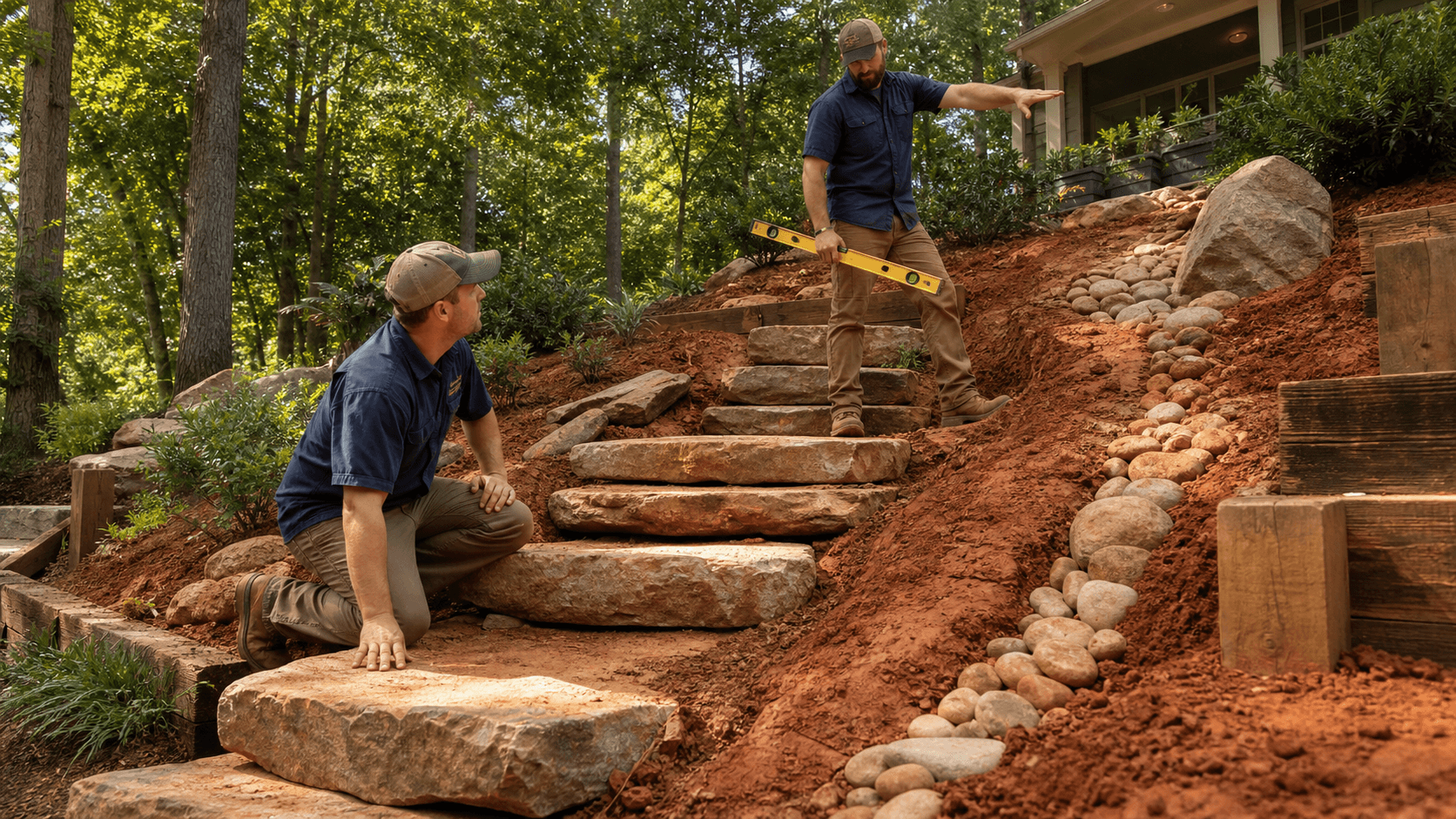
A flagstone patio in Vestavia Hills on a slope doesn't have to slide, crack, or push water toward your house. When the base, drainage, and edges are engineered for our red clay hills and hard summer rain, that patio can stay tight and solid for a long time.
At Wood-Palmer Outdoor Creations, our team leans on 75 years of combined leadership experience every time we build on these Vestavia Hills slopes. We've worked enough of these hillsides to see what fails first when the structure under the stone is weak. Below, is how we think about base build-up, geotextile fabric, edge restraint, and jointing or setting methods so your flagstone is not just pretty on day one, but still performing years later.
Reading Your Vestavia Hills Slope Before We Dig
Before any dirt is moved, we walk the site and read what the hill is telling us. Slope, soil type, and how water already moves across your yard drive almost every decision on a flagstone patio in Vestavia Hills.
We pay close attention to things like:
- Slope percentage and direction
- Red clay vs fill dirt vs soft topsoil
- Where water currently runs and ponds
- How close the house foundation and basement walls are
Common Vestavia Hills problems show up fast. Water may be running toward the house instead of away. Side yards can act like flumes, cutting channels in big storms. Some hillside areas have been filled in over the years, which means softer pockets that will settle if they're not built up correctly.
A basic site evaluation usually includes:
- Shooting grades so we know exact highs and lows
- Proof-rolling the subgrade to find soft or bouncy spots
- Locating downspouts, AC pads, weep holes, and crawlspace vents
- Watching where water naturally wants to leave the property
We're not trying to fight the hill. We design the build-up, drainage, and edge details to work with it. When the structure under the stone cooperates with the slope, you see less settlement, less shifting, and fewer water problems at the house.
Building a Stable Base in Compacted Lifts
On a slope, the base under your flagstone is doing the heavy lifting. "Compacted lifts" means we place base material in controlled thickness layers, then mechanically compact each layer before adding the next. We don't dump one deep layer and hope a few passes with a machine will tighten it up.
In Central Alabama clay, we typically use a crushed stone blend that:
- Packs tight when compacted
- Locks together instead of rolling like loose gravel
- Lets water drain through instead of holding a mud layer
A typical build-up for a sloped patio goes like this:
- Excavate to remove soft topsoil and reach firm subgrade.
- Proof-roll the area and fix any weak spots.
- Cut "step-down" benches into the hillside so the patio is terraced into the slope, not just sitting on top of it.
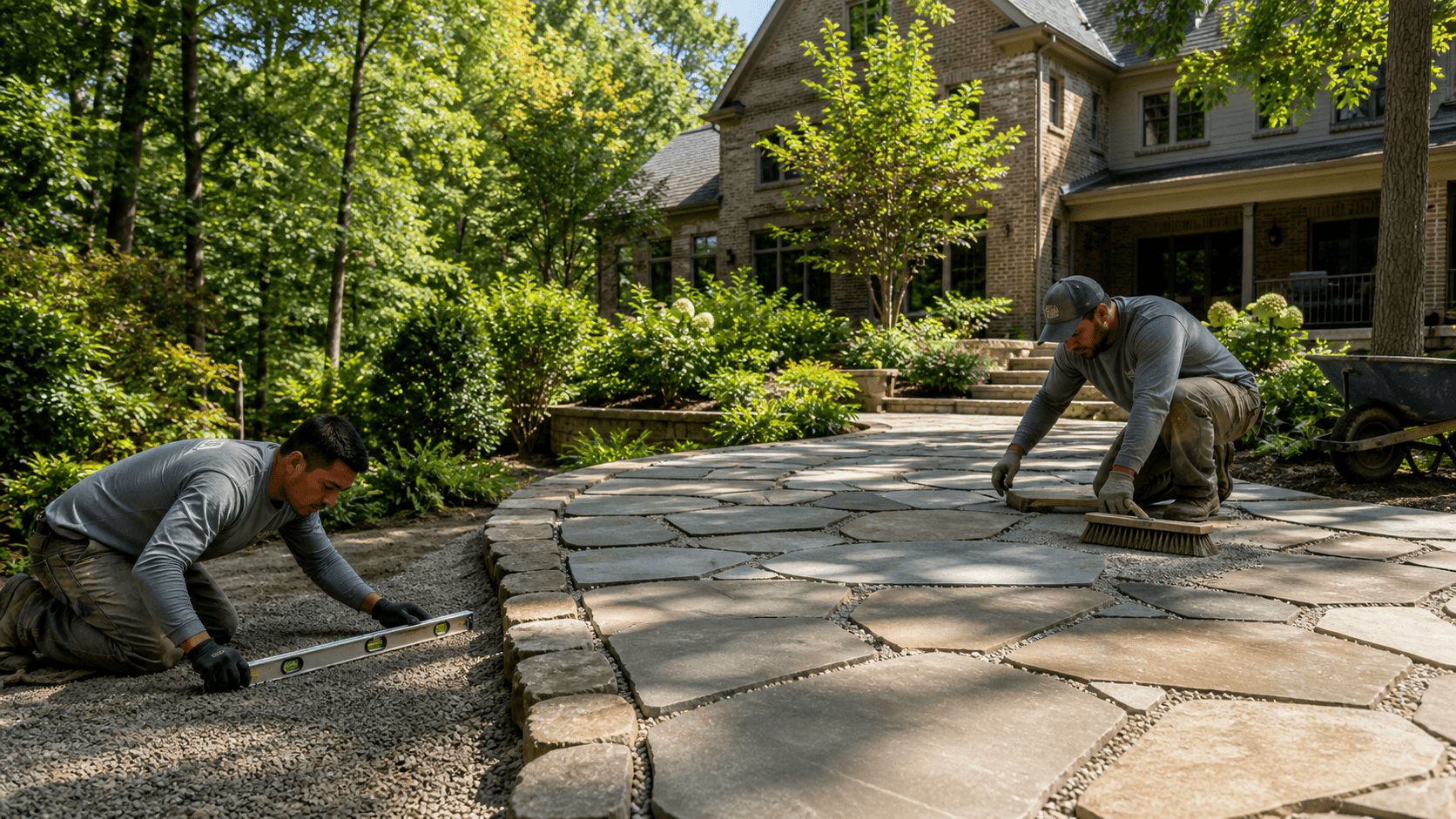
- Place base in lifts, often 3 to 4 inches at a time, and compact each lift with the right moisture content.
Moisture during compaction matters. Too dry and the rock stays loose. Too wet and it pumps. We use plate compactors or rollers and check compaction carefully, especially over any filled or disturbed soil where older work may have been done.
On the low side of the slope or where we're building up a terrace, base thickness usually increases. This adds stability and helps resist sliding, but it also affects material quantities and build time. That's part of why two patios that look similar on the surface can have very different structures underneath.
Geotextile Fabric as Insurance on Alabama Clay
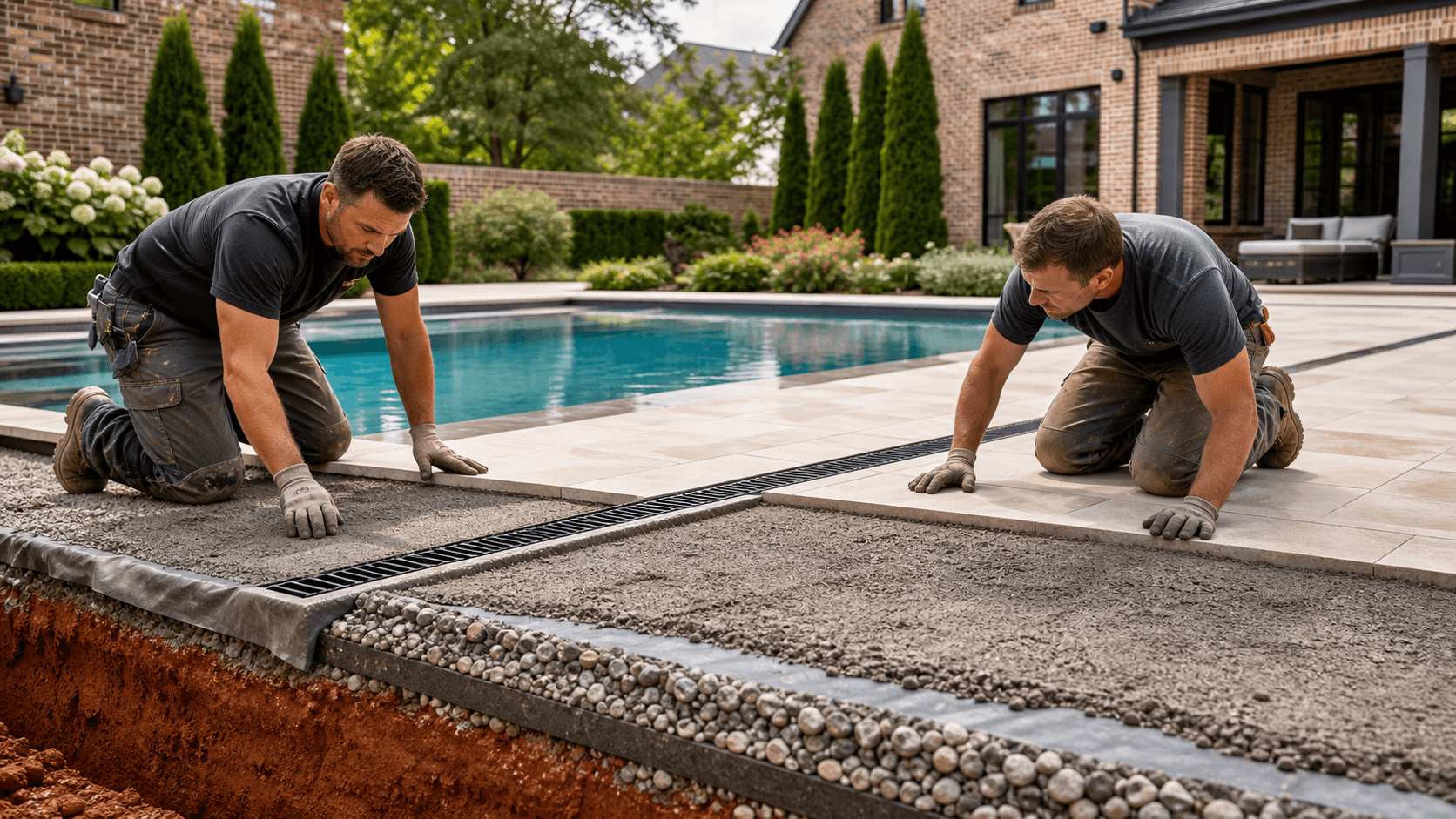
Geotextile fabric is a hidden layer that makes a big difference on our Vestavia Hills slopes. It's a woven or nonwoven sheet that sits between the soil and the base rock to keep the two from mixing.
On Alabama clay, geotextile helps by:
- Keeping crushed stone from pumping down into soft clay
- Stopping clay fines from migrating up into the base during wet and dry cycles
- Spreading weight from foot traffic and furniture over a wider area
We install fabric as continuous sheets, overlapping seams and turning it slightly up at the edges so there are no weak points that invite movement. Any cuts around drain lines, steps, or structures are done carefully so the fabric still works as a separation layer.
On steeper slopes, we often pair geotextile with French drains or surface drains to move groundwater and surface water away from the patio build-up. Keeping water from sitting in the base is one of the best ways to protect the long-term structural integrity of the hardscape and prevent settlement.
Holding the Edge so Stone Doesn't Creep Downslope
On a sloped flagstone patio in Vestavia Hills, edge restraint is what keeps gravity from slowly pulling the stone downhill. Without a solid edge, joints open up, stones spread, and you start to see trip hazards.
Common edge strategies include:
- Concrete haunch or toe, a hidden concrete "beam" along the edge
- Masonry or stone curb or border
- Steel or heavy-duty poly edging anchored into the base
Each one has a place:
- A buried concrete toe on the downhill edge works well for dry-laid patios on a slope.
- A stone or brick soldier course can act as both a design frame and a structural edge.
- Steel or poly edging often suits lighter-duty or flatter transition areas.
Good edge design also ties into steps, retaining walls, or existing concrete. When these pieces are tied together structurally, you get one system that resists movement, not a group of separate parts that can shift against each other.
Dry-Laid vs. Mortar-Set and Smart Jointing on Slopes
Flagstone can be set two main ways: dry-laid or mortar set.
Dry-laid flagstone sits on compacted base with a thin bedding layer, and joints are filled with sand, stone dust, or polymeric joint material. It's:
- More forgiving if there's minor movement in the base
- Easier to lift and repair individual stones
- Naturally more permeable when jointed correctly
Mortar set flagstone is bonded to a concrete slab or mortar bed with mortar or grout joints. It can feel "solid as concrete" underfoot, but the slab, grading, and drainage must be engineered very carefully so water doesn't get trapped against the house or under the stone.
On a gentler slope where we can pitch the surface cleanly to daylight and keep base layers draining, dry-laid is often a great choice. On a steeper, elevated patio where fall protection or higher loads come into play, a structural slab with mortar set stone might be the better long-term option.
Joint material ties the whole system together. On dry-laid patios, well-compacted joints help:
- Lock stones so they share load
- Slow down weed growth
- Shed surface water instead of letting it shoot straight into the base
On mortar set patios, joint width, depth, and pattern all matter. We plan joints to avoid "birdbaths" where water stands and to line up with control joints in the slab where needed. Around here, we also think about spring weed pressure, falling leaves, and how much maintenance the homeowner is comfortable with, then match joint choices to that.
For many Vestavia Hills properties, tying the patio into broader hardscape work or even future landscape lighting plans can also influence where we place joints, steps, and transitions, so the whole yard works as one system.
On Vestavia Hills slopes, the long-term success of a flagstone patio has more to do with what's under and around the stone than the stone itself. Careful grading, compacted lifts, geotextile separation, solid edge restraints, and smart jointing work together so the patio stays where it belongs and manages water away from your home.
Get Started With Your Project Today
Transform your backyard into a space you love spending time in with a custom-designed flagstone patio in Vestavia Hills. Ready to get started? Give us a call at (205) 305-7780, send an email to info@woodpalmer.com, or use our contact form to talk about your property.