Build a Pool Deck That Stays Put In Alabama Clay
A pool deck should not start moving a year or two after it is built. In Central Alabama, that only happens when the base and drainage are treated as structural work, not just part of the finish. Our red clay, heavy rains, and short dry spells put more stress on a pool deck than many people realize.
Pool decks in the Birmingham area behave differently than decks on sandier Gulf Coast soils or solid mountain rock. Clay holds water, then shrinks hard when it dries. That movement shows up as settling, heaving, efflorescence on the surface, and coping that starts to shift and separate. When Wood-Palmer Outdoor Creations designs a pool deck hardscape in Birmingham, we start from the ground down, planning the base, drainage, and coping details with an engineering-focused mindset and 75 years of combined leadership experience. Instead of treating a pool deck as a stand-alone feature, we look at how the soil moves, what a true structural base should be, how to manage water, and how tying hardscape, landscape, structures (including outdoor kitchens), irrigation, and landscape lighting together helps the whole outdoor environment work as one system.
That one team, one plan, one standard approach is what keeps the deck, surrounding grades, and adjacent features working together over time.
How Birmingham Clay Moves Under Your Pool Deck
Central Alabama is known for dense red clay. Around many estate and lake properties you also see shallow bedrock, steep slopes, and in newer neighborhoods, pockets of fill dirt that were pushed around during home construction. All of that creates a mixed subgrade under and around your pool.
Clay acts like a sponge. When it is wet, it swells and loses strength. When it dries, it shrinks and cracks. If a pool deck is sitting right on top of that movement, different areas can settle at different rates. That's called differential settlement, and it's a big reason pavers, natural stone, and even concrete toppings start to move.
Water is the other half of the story. If water gets trapped:
- Against the pool shell
- Under the coping
- In low pockets in the base
it can build pressure, wash out fine materials, and slowly create voids. That's when homeowners start to notice hairline gaps at the coping line, mastic joints separating, or a corner of the deck that suddenly feels hollow.
Those hidden moisture and movement issues often show up as:
- White powdery efflorescence on pavers or stone
- Loose or rocking coping pieces
- Trip edges at drains and transitions
- Cracked grout at the waterline
Before anyone talks about paver patterns or stone choices for a pool deck hardscape in Birmingham, there needs to be a clear understanding of the native soil profile and how water wants to move across and under the site. That's the kind of on-site evaluation our leadership team stays directly involved in.
Building A Stable Base For Long-Term Pool Deck Performance
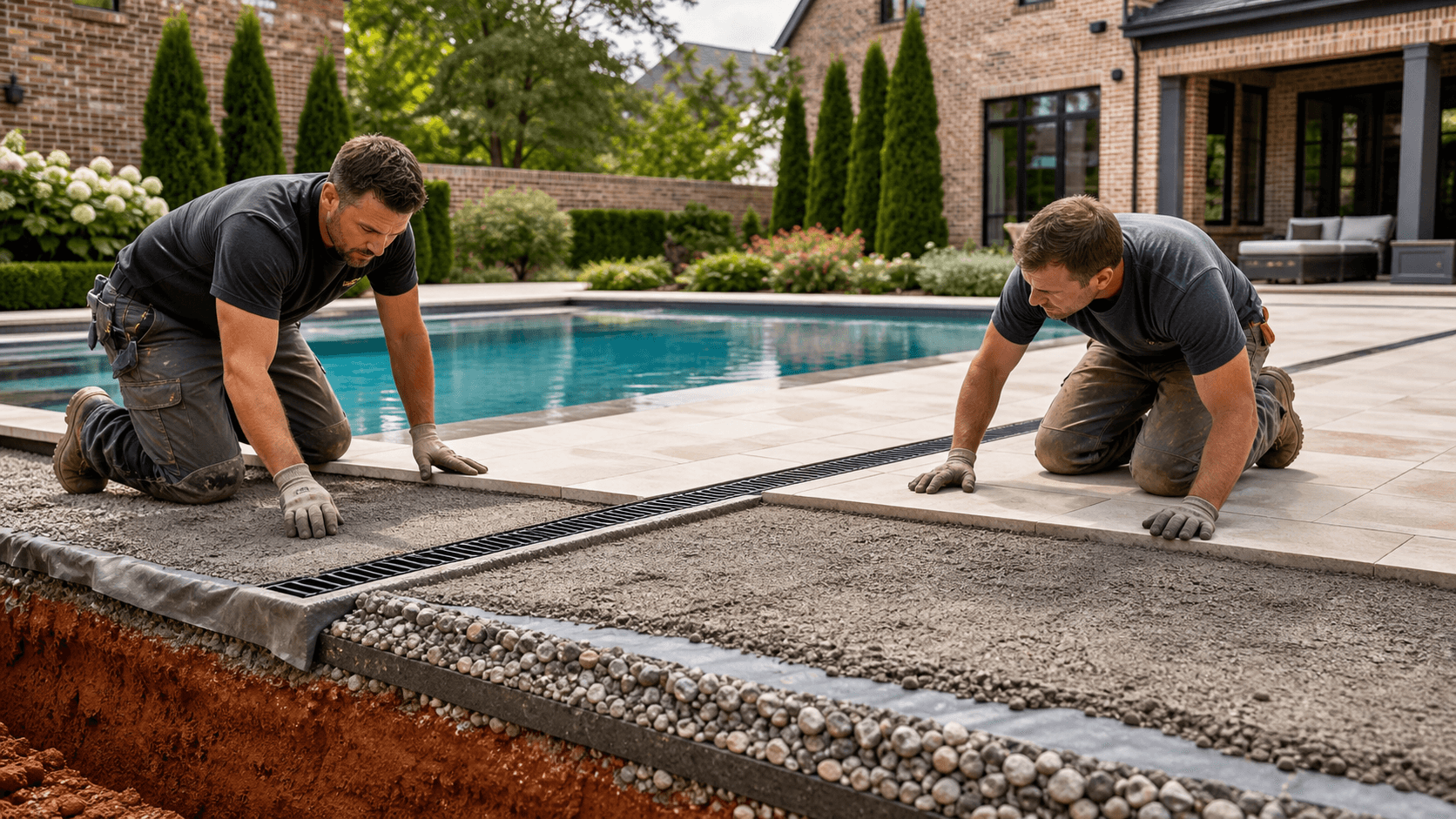
A long-lasting pool deck starts with a structural base, not just a thin layer of sand or screenings under the surface. The base has three main parts: subgrade preparation, aggregate base thickness, and proper compaction.
Subgrade preparation means:
- Stripping out topsoil, roots, and organic material
- Identifying and removing poor fill that was loosely dumped
- Shaping the subgrade with the right slope away from the pool
On some projects, especially around the pool beam or where the deck meets a lawn or a slope, a contractor may over-excavate and replace bad soil with compacted stone. This creates a stronger, more uniform seat for the deck that's not as sensitive to clay shrink and swell.
Compaction is where many projects fall short. Proper compaction includes:
- Placing stone in lifts, not all at once
- Hitting target moisture content so the stone locks together
- Using plate compactors or rollers sized for the depth of base
Different deck materials call for slightly different base strategies. For example:
- Pavers often sit on a compacted stone base with a thin bedding layer
- Natural stone may need a thicker base and tighter control of elevations
- Concrete toppings might be paired with open-graded stone in some areas to allow water to move away from the pool shell
We also pay attention to everything that has to pass under that deck. Sleeves for structures, lines for irrigation, and conduit for landscape lighting all need to be planned and installed without cutting through the base later and creating weak trenches that can settle. That integrated planning is where an experienced design-build team makes a difference.
Wood-Palmer Outdoor Creations builds pool decks and the surrounding hardscape systems; we coordinate closely with pool builders so the shell, beam, and deck details work together instead of fighting each other.
Drainage Design That Protects Your Deck And Pool Shell
The main goal of drainage around a pool is simple: move surface and subsurface water away from the pool shell, coping, and house, and get it to a safe discharge point without creating soggy spots or erosion.
Grading around the deck sets up how water behaves from day one. We set gentle, consistent fall so water runs:
- Away from the pool edge, not back toward the shell
- Away from the house foundation
- Toward planned drains or outlets, not into dead-flat pockets
On Birmingham clay, flat areas tend to hold water longer, so we avoid slopes that are technically "level" but don't drain in the real world.
Common drainage tools around a pool deck include:
- Strip drains at or just behind the coping line
- Area drains in low interior pockets
- Channel drains at door thresholds or tight pinch points
- French drains to collect subsurface water and carry it to daylight or another appropriate discharge point
When drainage is poor, water lingers in the base and under the coping. That encourages efflorescence, washes out joint sand, and lets fine materials migrate, which leads to shifting coping and settling right after heavy fall and winter rains.
Because we work under one plan for hardscape, landscape, structures (including outdoor kitchens), irrigation, and landscape lighting, we make sure roof downspouts, irrigation spray patterns, and deck drainage work together instead of fighting each other. There's no benefit in building a solid drain system if a nearby downspout dumps straight onto the deck or an irrigation head sprays the same joint day after day.
Keeping Coping Tight And Efflorescence Under Control
Coping is the trim piece that ties the pool shell to the deck. It's usually the first place movement shows up, because the shell and deck want to move differently and the joint is right at eye level.
A well-detailed coping assembly considers:
- How the coping bonds to the pool beam
- The type and thickness of the setting bed or mortar
- Expansion and control joints between the coping and deck
The idea isn't to freeze everything in place, but to let the pool shell and deck move slightly without creating wide cracks, loose pieces, or sharp lips.
Efflorescence is a natural reaction when water moves through cement-based materials and brings soluble salts to the surface. You often see it as a white film on pavers, natural stone, or grout lines. While it can't be eliminated completely, it can be reduced by:
- Using appropriate base and bedding materials
- Managing water so it doesn't sit in the base for long periods
- Detailing joints so water has controlled paths to exit
Less trapped water under the deck means fewer callbacks for loose coping, popped tiles, or spalled concrete edges. Over time, that stability is what separates a pool deck that looks tight year after year from one that always seems to be shifting.
If you're planning a pool deck in Central Alabama or you're seeing signs of movement around an existing pool, let's talk about your property. Call us at (205) 305-7780, email us at info@woodpalmer.com, or reach out through our contact form at woodpalmer.com/contact.
Get Started With Your Project Today
Transform your backyard into a relaxing retreat with a custom-designed pool deck hardscape in Birmingham that fits your home and lifestyle. At Wood-Palmer Outdoor Creations, we listen to your ideas and guide you through materials, layout, and features so the final result feels effortless and inviting. If you are ready to talk through options, timelines, and budget, simply contact us and we will help you map out the next steps.