Build a Stone Patio That Actually Lasts in Birmingham Clay
Natural stone patios in Birmingham don't sit on friendly beach sand. They sit on heavy red clay that loves to hold water, move when it gets wet, then crack when it dries. If the base and drainage aren't engineered for that, even the nicest stone will start to move, settle, and separate from the house.
At Wood-Palmer Outdoor Creations, we deal with that clay every day across Central Alabama. Our summer storms, hard downpours, and winter freeze-thaw cycles all push on the base under a patio. On every patio project, we walk homeowners through how we think about geotextile fabric, open-graded versus dense-graded base, edge restraint, and how the patio ties into yard-wide drainage so water doesn't end up trapped against your foundation. These are the same structural talks we have on-site before a single stone gets set, shaped by our 75 years of combined leadership experience.
This kind of structural planning supports the way we design and build patios as part of a larger hardscape system, not just as a standalone surface.
What Birmingham Clay Does to a Stone Patio Base
Central Alabama's red and yellow clay is straightforward but unforgiving. It has:
- Low permeability, so water doesn't pass through easily
- High plasticity, so it swells when wet and shrinks when dry
- A tendency to hold water near the surface
- Enough apparent strength to fool you into thinking "this is good enough" until it moves
Under natural stone patios in Birmingham, that shows up as pumping underfoot, heaving in spots, and stones that settle or tip at the edges. When the base and subgrade aren't shaped and separated correctly, edges crack, mortar joints open, and small voids turn into trip hazards.
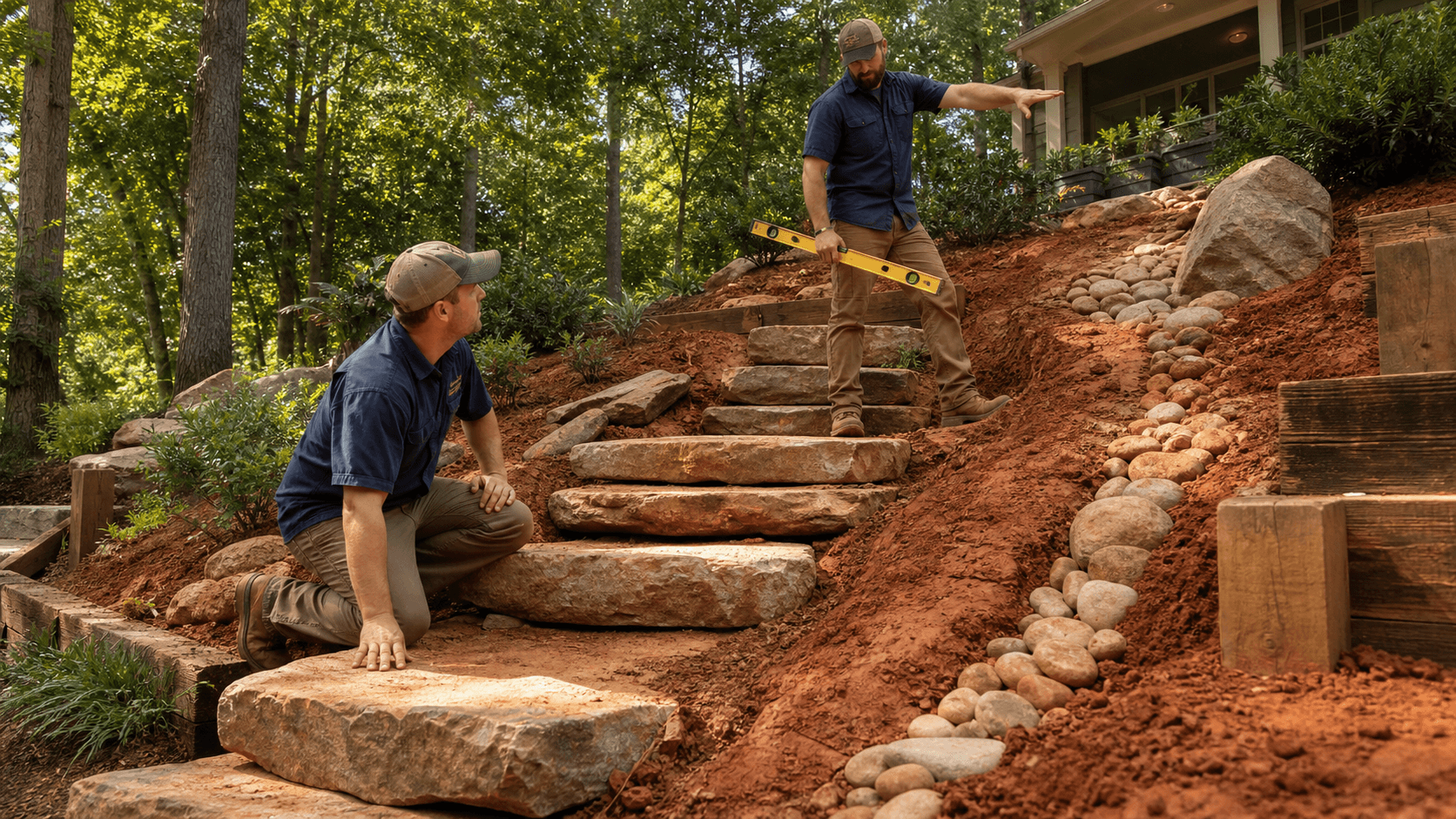
We also work on plenty of sloped lots in places like Hoover, Vestavia, and around Lake Martin. On those hills, water is always looking for the easiest path. If a patio sits like a flat plug on top of that slope, water will travel under it, soften the clay, and start eating away at the base.
On-site, we talk a lot about two types of drainage:
- Surface drainage, what you see: water shedding off stone and lawn
- Subsurface drainage, what you don't see: water moving through base rock and clay
You can have a patio that looks like it drains fine on top but holds water like a bathtub underneath. That's why separation fabric, correct base gradation, and positive flow away from the house are non-negotiable parts of the structure when we design and build patios that tie back into our wider hardscape and drainage services.
Choosing the Right Geotextile Over Alabama Red Clay
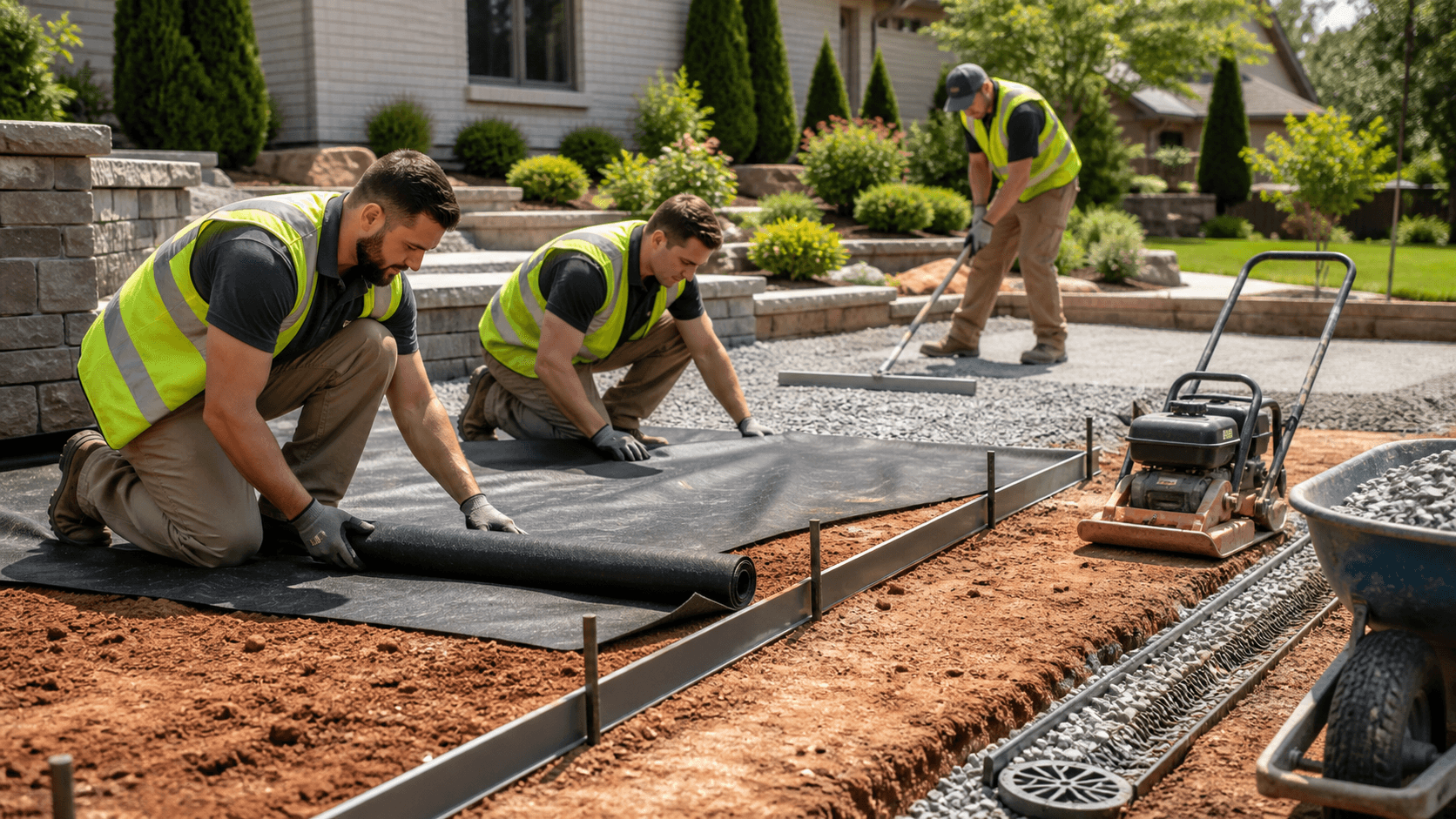
Geotextile fabric is the quiet worker in this system. It sits between the clay subgrade and the stone base, and its main jobs are:
- Separation, keeping clay from mixing up into your base rock
- Filtration, letting water pass through while holding fine soil in place
- Some reinforcement, helping spread loads across softer spots
In simple terms, there are two main fabric types we talk through with homeowners:
- Woven geotextile, which looks like a tight plastic weave. It has higher tensile strength and does a solid job with separation when the clay wants to pump and move.
- Nonwoven geotextile, which looks more like felt. It lets water move through more easily and can help when we expect groundwater moving through the subgrade.
Around Central Alabama, we often see a few common conditions: fresh clay backfill right next to newer foundations, older compacted native soils a bit farther out, and lakefront properties where we might have perched water tables. Those change which fabric we lean on, and sometimes we use both in different zones.
Brand names matter less than performance. Thickness, puncture resistance, and proper overlap at seams carry more weight than a fancy label. Thin, bargain fabric on top of Birmingham clay usually means the clay will punch through, mix with the base rock, and cause long-term settlement.
Our leadership is involved in layout and layering decisions so we match fabric type and coverage to each property instead of using a generic one-size spec. That's where those 75 years of combined leadership experience show up in the details you don't see but feel underfoot.
Open-Graded vs. Dense-Graded Base in Heavy Clay
Once the subgrade is shaped and the fabric is down, the next key choice is base stone.
Dense-graded base, often called crusher run, is a mix of stone of different sizes plus fines. It compacts very tight, carries load well, and works great when you want a stiff layer. The tradeoff is that water moves through it more slowly, so you've got to give that water a planned exit.
Open-graded base is clean stone with little or no fines. Think larger rock with gaps between pieces. It creates a structural, free-draining stone reservoir. That's why it's popular under natural stone patios in Birmingham where we may want to collect and move water. But if you don't protect it from clay, that rock will slowly fill with fines and stop draining.
A few patterns we use a lot when we're tying a patio into a broader drainage and hardscape plan:
- Dense-graded base tight to the foundation where we want to control water movement
- Open-graded base in zones where we're intentionally collecting water to send to a French drain or outlet
- Layered or blended systems where one type transitions to the other across the yard
Clay migration is a big concern. Without proper geotextile, every storm can pull a little bit of clay into that open-graded stone. Over time, that stone bed turns into a hard, non-draining chunk. That's why we often build the section like this: compacted, shaped clay subgrade, quality geotextile, then a base design that might start dense-graded near the house and transition to open-graded as we move out toward a drain or swale.
Edge Restraint Choices That Survive Alabama Seasons
Edge restraint isn't just about stopping the last row of stones from sliding sideways. In clay, it helps lock the whole hardscape system together so it moves as one unit instead of spreading or racking.
Common options we use include:
- Concrete haunch or backer placed behind the stone edge over proper base
- Heavy-duty paver edge restraints anchored into the compacted base, not loose soil
- Cast-in-place concrete or masonry curbs when the design calls for a strong visual edge
On steeper backyards, like we see in Homewood or Mountain Brook, we may combine a concrete haunch with dowels or tie that edge into a small retaining structure. The idea is to resist both gravity pulling downhill and clay that may shift under seasonal moisture swings.
Our winters are milder than in colder states, but we still see freeze-thaw. Edge restraints need to be buried to the right depth, braced by compacted base, not sitting in topsoil that'll turn to mud when wet. Poorly placed concrete edges can also create little water dams. A well-planned edge helps steer runoff toward drains, swales, or lawn without letting water run under the patio.
Tying the Patio Base into Yard-Wide Drainage
The bigger goal is simple: a natural stone patio in Birmingham should be part of the yard's full drainage plan, not a flat island that traps water at the foundation.
We shape both subgrade and base with that in mind:
- The finished stone usually has a gentle pitch away from the house
- The base layers below follow that same pitch
- We avoid reverse slopes that sneak water back toward walls, doors, or slabs
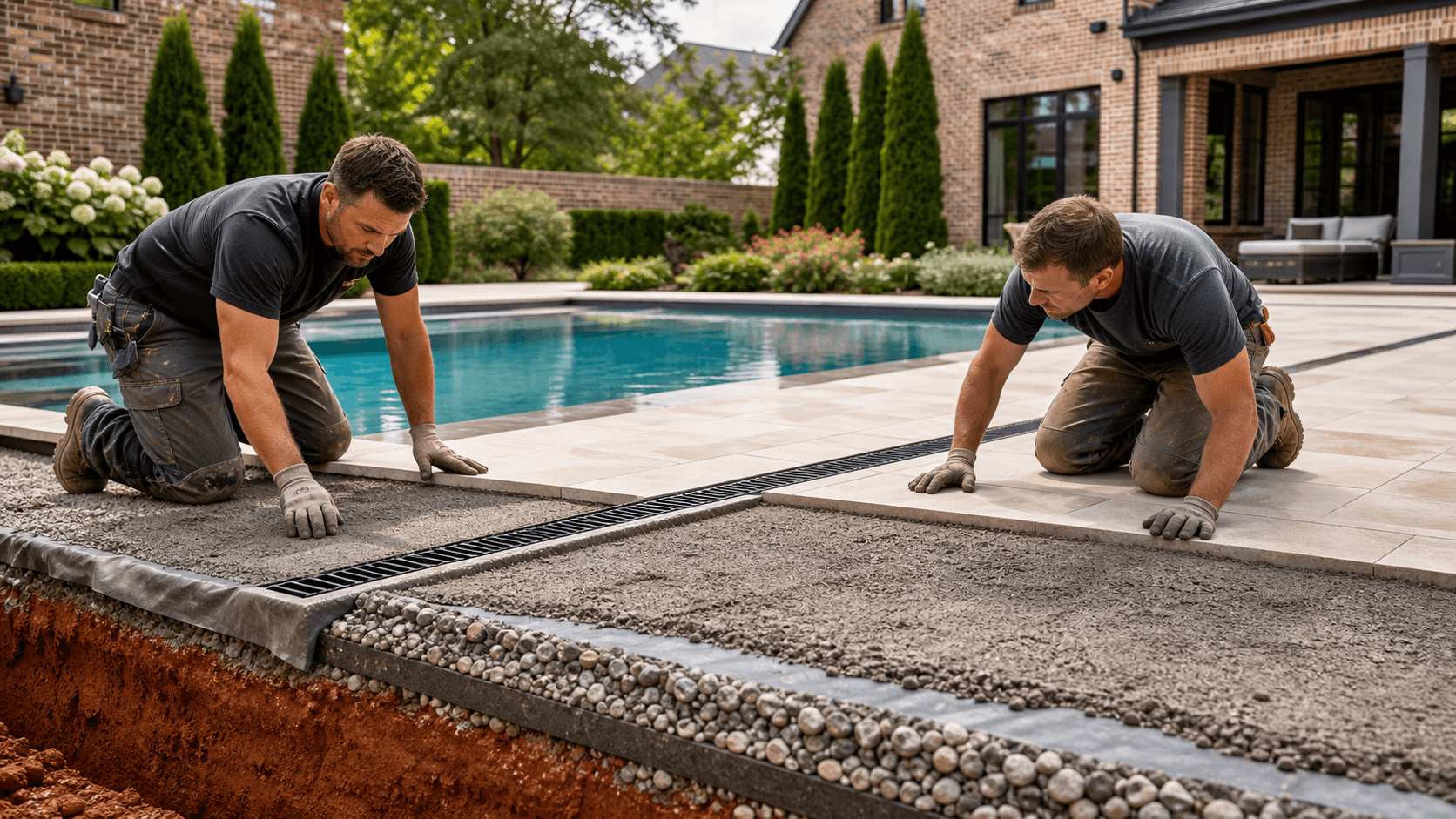
From there, we match the drainage tools to the property. At the line where the house meets the patio, we might use a surface drain or channel drain if roof runoff and patio runoff meet. Inside or alongside an open-graded base, we may add perforated pipe that carries water to daylight, a drain box, or a designed outlet point. Swales and subtle regrading can move water across the yard and into planting beds or toward structures like pavilions and outdoor kitchens.
We also pay close attention to what's already there. Existing foundation drains, weep holes, and slab thresholds should never be buried or bridged with base material. Stacking stone or base above a threshold can trap water against the house and create splash or seepage issues.
On estate and lakefront properties, where hardscape, plantings, irrigation, and landscape lighting all tie together, stormwater runs through every part of that system. When we design, we treat the whole yard as one connected build so that each new patio helps move water in the right direction instead of fighting against the Birmingham clay underneath it.
Get Started With Your Project Today
Transform your backyard into a space you love spending time in with custom-designed natural stone patios in Birmingham. At Wood-Palmer Outdoor Creations, we listen carefully to your ideas and guide you through material choices, layout, and design details that fit your home and lifestyle. If you are ready to talk through options, schedule a consultation or contact us with a few details about your project so we can help you plan the next steps.