Alabama Clay, Birmingham Patios, and Long-Term Performance
Natural stone patios in Birmingham have a look you just cannot fake. They feel solid, timeless, and right at home against brick homes and big shade trees. But under every stone, there is Alabama red clay, and that clay has a lot to say about how long that patio really stays flat and tight.
Around Central Alabama, you are not just placing stone on the ground. You are building a structure on reactive soil that swells, shrinks, and holds water. That means base preparation, grading, and drainage are not "extras," they are the whole game. With 75 Years of Combined Leadership Experience working in this terrain, we design every patio from the clay up, not the stone down.
By mid-summer, problems from spring rains and winter movement tend to show up. Joints open, corners lift, and low spots collect water. Those surface issues almost always trace back to how the clay underneath was handled on day one.
How Alabama Red Clay Really Behaves Under Stone
Most Birmingham yards share a similar profile once you scrape off the topsoil. You hit dense, sticky, high-clay subsoil, often with scattered rock. That clay has decent bearing strength when it is handled correctly, but it moves with moisture more than many people expect.
Clay does a few key things under a patio:
- Swells when it is wet and shrinks when it dries
- Holds water in place longer than sandy soil
- Transfers moisture up into the base through capillary action
When clay swells, it pushes up on the base and the stone above it. That can show up as heaving or a high ridge. When it dries out and shrinks, the base can settle and stones can dip or rock underfoot. Over a couple of seasons, that cycle repeats and the movement adds up.
Water is the other piece. Alabama clay is good at grabbing water and hanging on to it. If a patio traps water against the clay, that moisture has nowhere to go. The base stays soft, the clay swells, and freeze-thaw nights can pop joints or shift individual stones.
Across Central Alabama, common lots each behave a little differently when the clay moves:
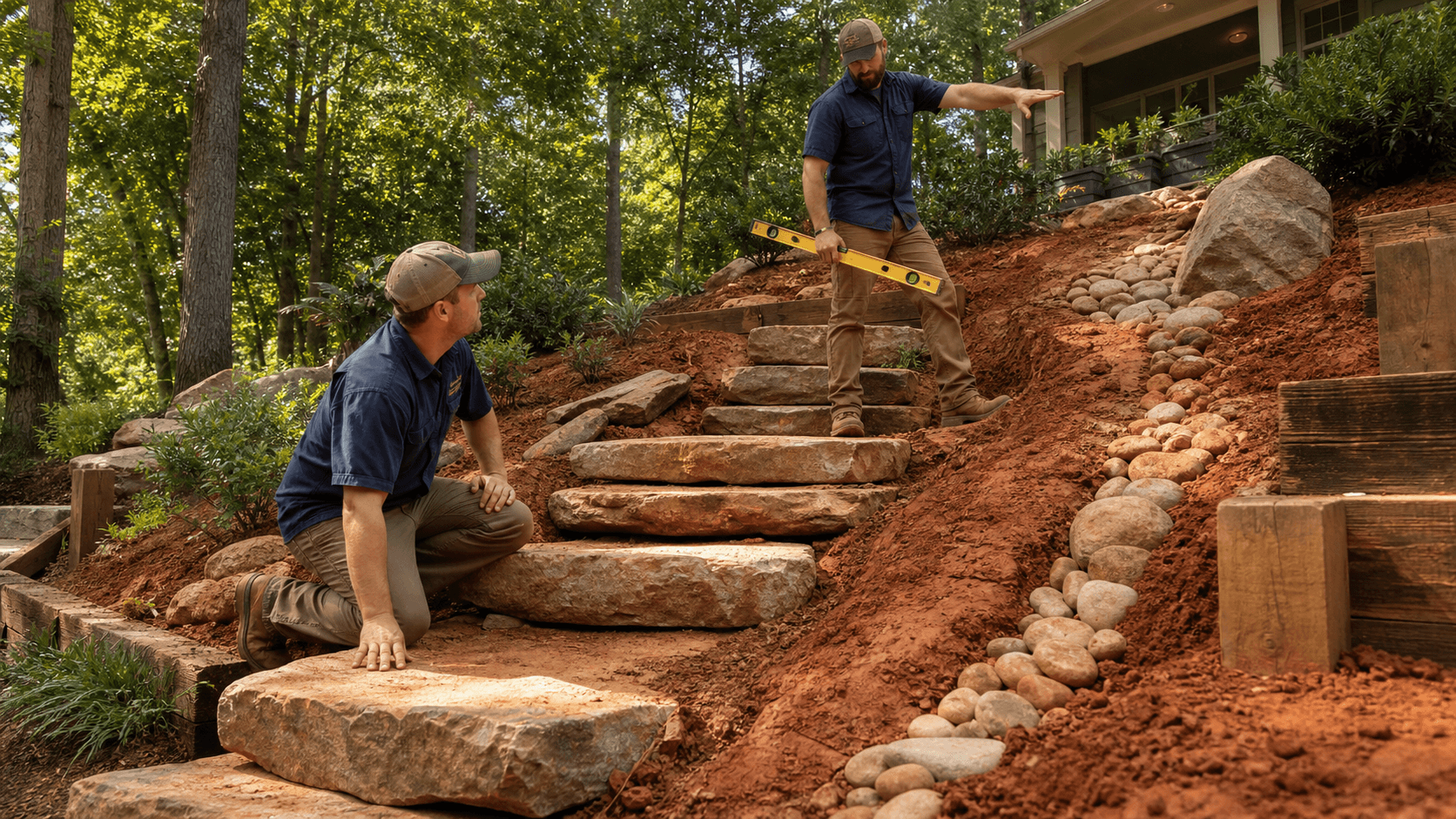
- Slopes off Shades Mountain may shed water fast, but lateral movement can pull patios apart if they are not keyed in correctly
- Lake properties often have a mix of fill and native clay that responds unevenly if the base is not engineered as one system
- Flat backyards in newer subdivisions tend to collect water in small pockets, which can soften isolated areas under the stone
What Natural Stone Patios in Birmingham Need Beneath Them
Natural stone patios in Birmingham need more than a thin layer of sand on top of red clay. They need a layered system built for this soil and this climate.
A typical structural build-up on Alabama clay includes:
- Subgrade preparation: stripping organics, proof-rolling to find soft spots, and addressing any pumping clay
- Subgrade conditioning: scarifying tight clay so it bonds with the base rather than slicking off like glass
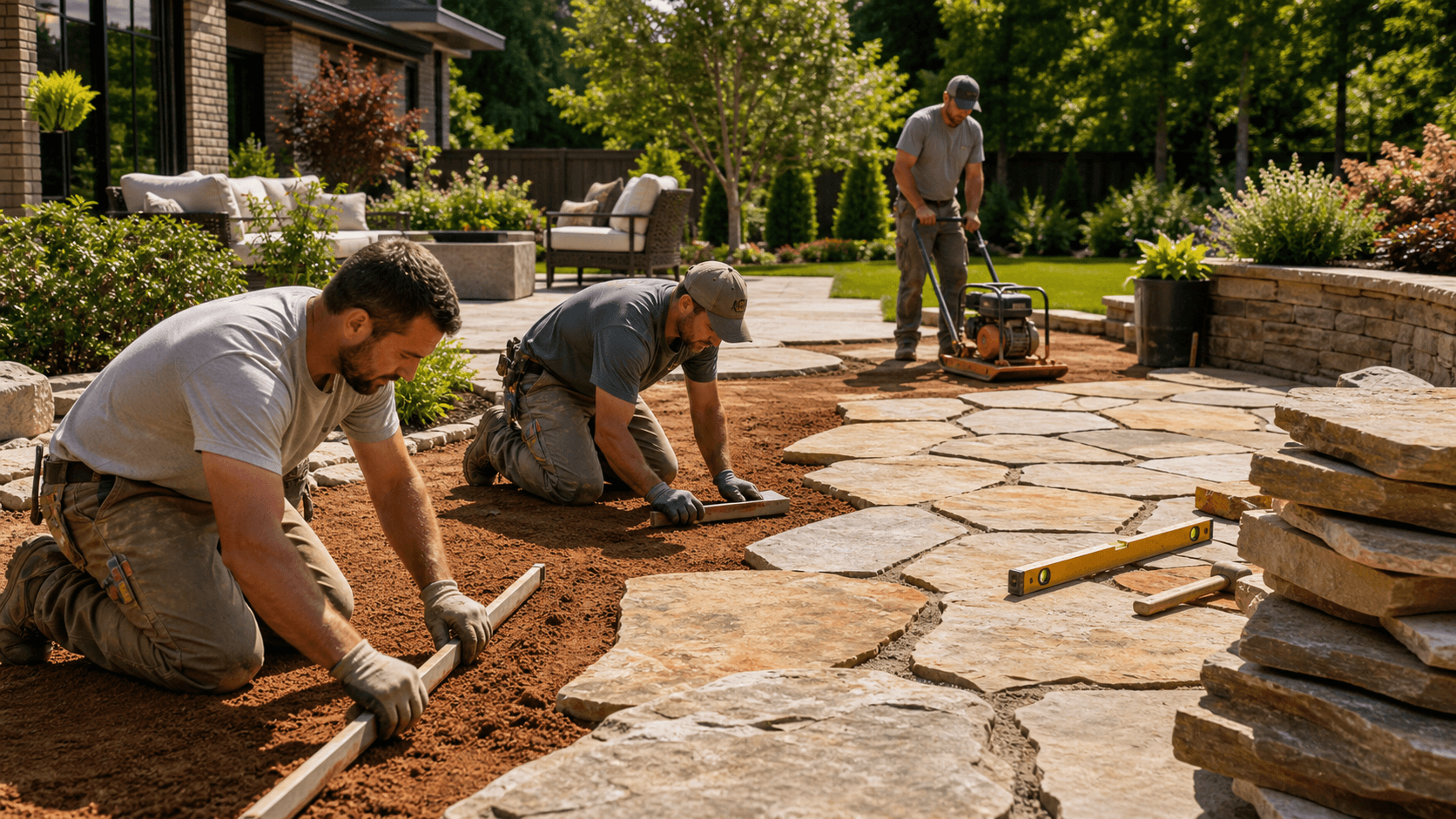
- Aggregate base: installing graded stone in controlled lifts, compacting each lift to a set standard
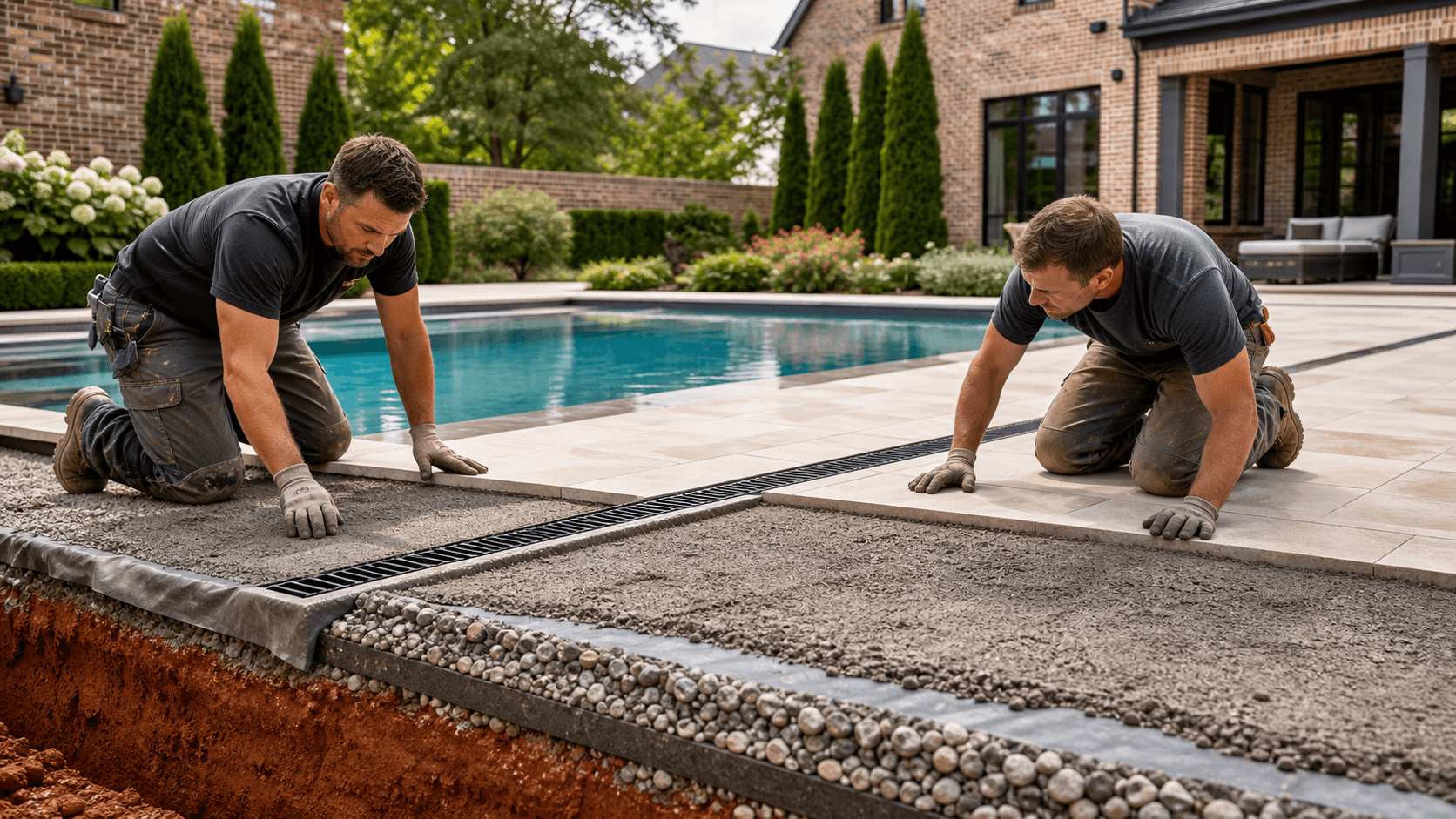
- Bedding layer: setting stone on a stable, drained layer that will not wash out or pump under load
On clay, compaction is not just a quick pass with a plate tamper. The thickness of each lift, the gradation of the stone, and the moisture content during compaction all matter. Too thin and you waste effort. Too thick and you get a hard crust on top with loose material under it.
It is also about how the patio ties into everything around it. When the hardscape is locked into structures like seat walls, steps, or an outdoor kitchen built as part of those structures, and those are founded to the right depth in the clay, the whole zone tends to move together instead of fighting itself. That unified approach reduces cracking and eliminates little "hinge points" where clay movement can show up as a single loose edge or corner.
Drainage and Grading That Work with Alabama Storms
Central Alabama storms are intense. When a big summer cell sits over Mountain Brook, Vestavia Hills, or Homewood, that patio can see a lot of water in a short time. If the surface and subsurface are not planned for that, the clay underneath will pay the price.
Good grading on a patio is simple to explain, but easy to get wrong:
- A steady pitch away from the house and other structures
- Defined water paths that do not cut across joints or walkways in random spots
- No flat low pockets where water can stand and soak into the clay
Sometimes surface grading alone is not enough. On tighter lots or heavier clay, subsurface drainage becomes part of the build. That might mean French drains, perimeter drains around structures, or drainage mats that relieve water from under the base. The goal is always the same: get water away from the clay and let the base stay stable.
Hardscape, plant areas, and landscape lighting all need to respect water flow. Plant beds that block runoff, or lighting conduits that pinch a drain line, can redirect water back toward the patio. Long-term structural integrity depends on every element working with the same drainage plan, not each one solving its own problem in isolation.
Tying Patios Into the Rest of Your Outdoor Environment
A patio is rarely its own little island. In most projects, it works with structures, outdoor kitchens built as part of those structures, walkways, and planting areas as one connected outdoor room.
That means foundations and support elements have to be tuned for Alabama clay. Footing depths for structures, wall construction for seat walls or retaining walls, and step foundations all adjust based on whether we are bearing on native clay, filled areas, or rock. When those details are coordinated, the different parts settle together, rather than pulling apart at the joints.
Planting and irrigation matter too. Deep-rooted plants placed correctly can help stabilize surrounding soil. On the other hand, shallow roots right at the edge of the stone, or irrigation heads that overwater one corner, can soften the clay and telegraph movement into the patio edge.
We also think through landscape lighting around the patio early. Conduit runs, junction boxes, and fixture bases are laid out so repairs or upgrades later do not require digging through the structural base or disturbing the clay subgrade that is working well.
Planning for Birmingham Heat, Cold, and Year-Round Use
Central Alabama sees hot summers, mild winters, and long stretches of wet weather. Clay responds to all of it. As moisture levels swing with the seasons, the patio system has to ride along without constant touch-ups.
A few design choices help natural stone patios in Birmingham handle those cycles:
- Stone thickness that matches the span and load, not just the look
- Jointing methods suited to movement and drainage, whether flexible or more rigid by design
- Edge restraints that lock the field in, so seasonal clay shifts do not start at the perimeter
Use patterns matter as well. An outdoor kitchen integrated into your structures with heavy appliances, a path that carries traffic to a pool, or a spot that always holds large furniture all load the base differently. We design thickness, reinforcement, and joint materials with those loads in mind, not just the empty patio on drawing day.
Owners at Wood-Palmer Outdoor Creations stay involved in those decisions. We walk the site with you, read how the yard drains now, and listen to how you actually plan to use the space. That helps us shape a patio structure that works with your Alabama clay instead of fighting it year after year.
Get Started With Your Project Today
Transform your backyard into a space you truly enjoy with our custom-crafted outdoor designs. Explore how our natural stone patios in Birmingham can enhance your home's beauty, functionality, and value. At Wood-Palmer Outdoor Creations, we work closely with you to understand your vision and bring it to life with careful planning and skilled installation. Let's talk about your project—give us a call at (205) 305-7780, email info@woodpalmer.com, or contact us online to get started.