Why Birmingham Nights Depend on More Than Just Fixtures
Good landscape lighting in Birmingham is not something you can copy from a catalog photo. What works in Arizona gravel or a flat coastal yard will not behave the same in Central Alabama clay under a tall oak canopy. Our trees, our red dirt, and our hills change how every beam of light actually shows up at night.
High-end homes around Mountain Brook, Vestavia Hills, and the Greater Birmingham area often sit under layers of mature oaks and pines. That canopy blocks, filters, and redirects light in ways most fixture brochures never mention. Add heavy clay soil that swells, shrinks, and holds water, and you quickly see why this is more than just picking a pretty path light.
At Wood-Palmer Outdoor Creations, our team brings 75 years of combined leadership experience working with this exact terrain, clay, and dense tree cover. We treat landscape lighting like a structural build. Around here, good lighting is as much about soil, roots, and drainage as it is about fixtures and wattage.
How Tree Canopies Shape Nighttime Views
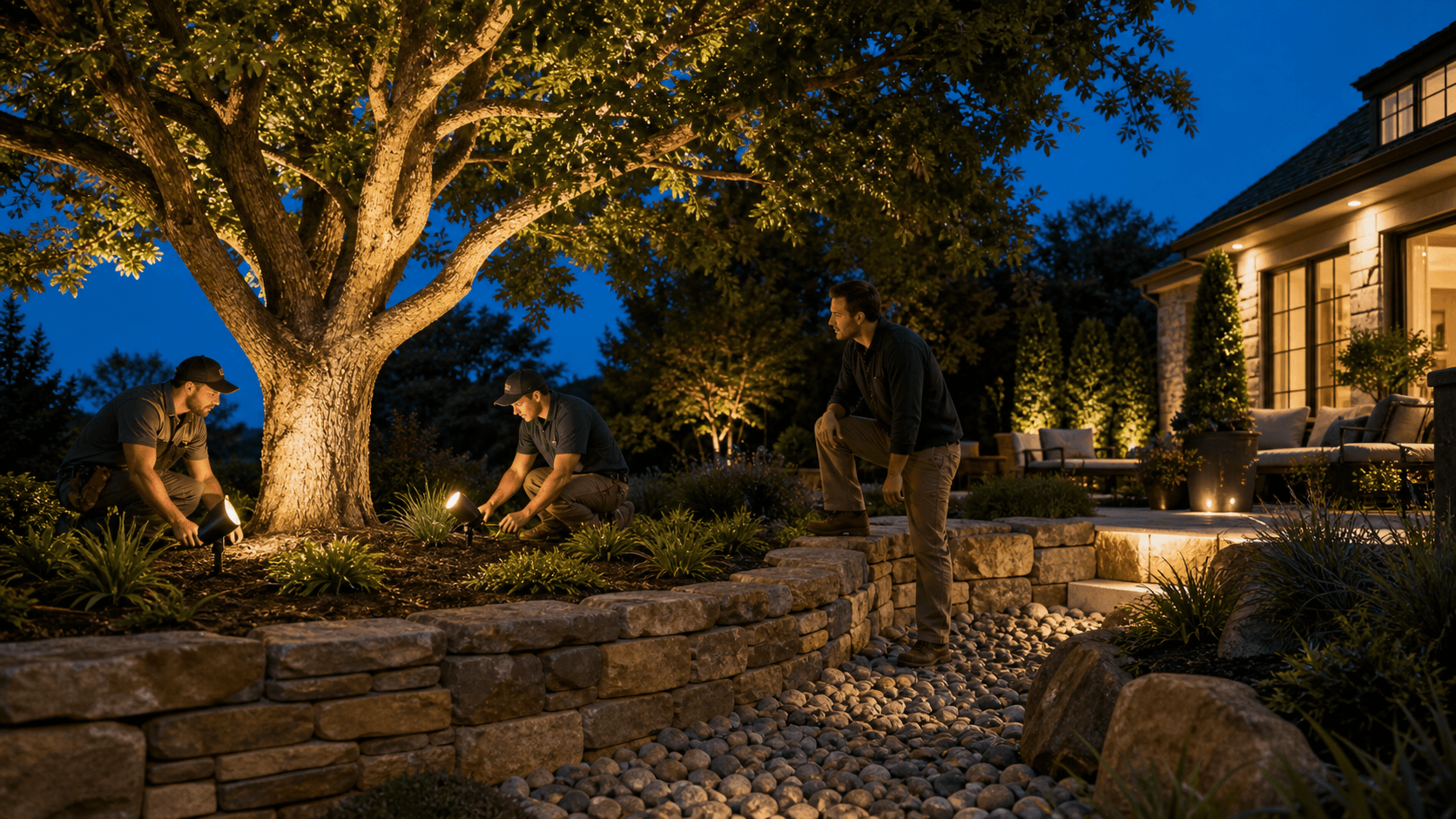
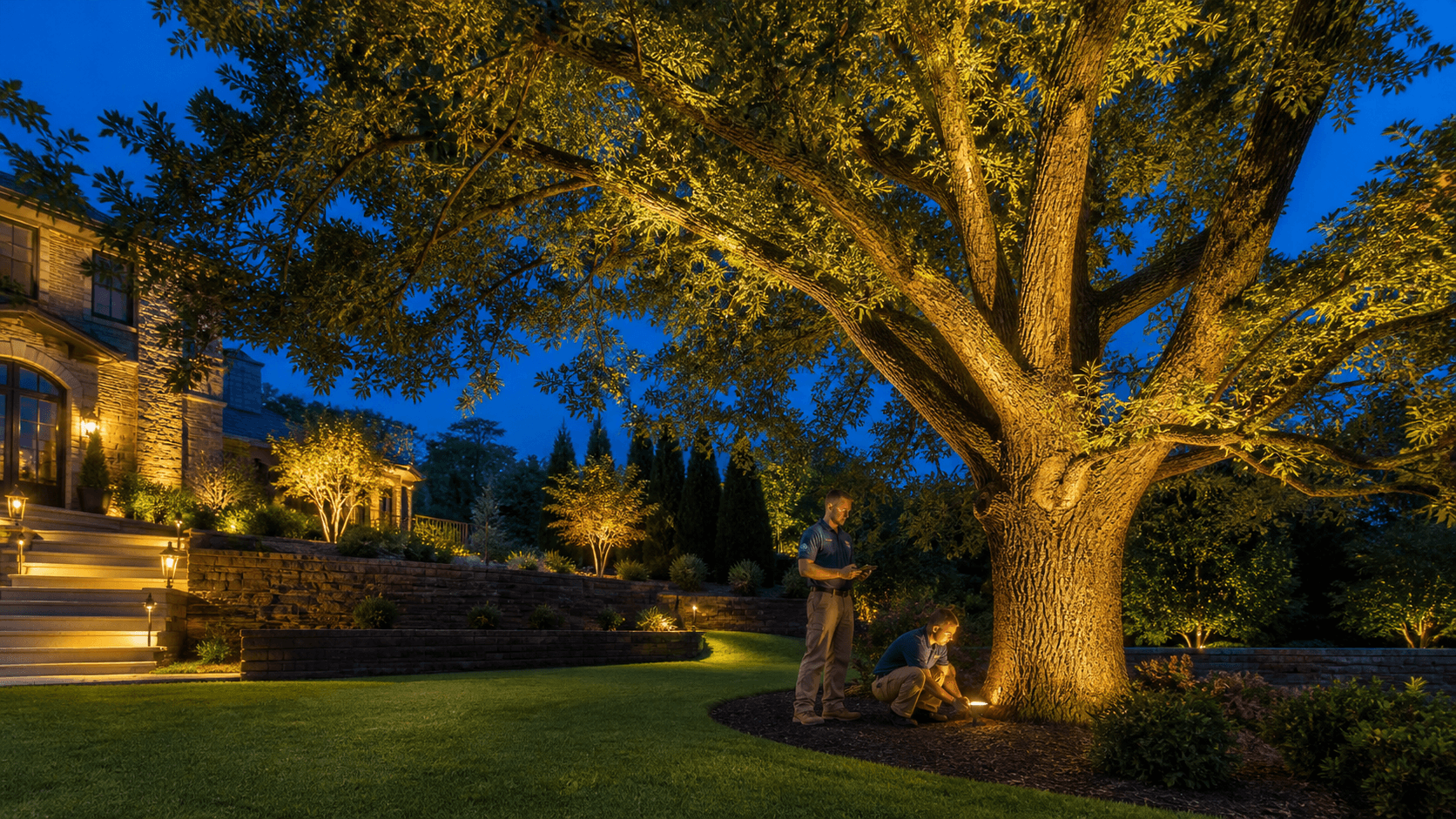
In Birmingham, the tree canopy creates a vertical job site. You're not lighting a flat postcard, you're lighting three different levels.
We think about it in layers:
- Ground plane: paths, steps, beds, turf
- Understory: small trees, shrubs, lower branches
- Canopy: tall oaks, pines, and high structure
Each layer needs its own strategy. If you only light the ground plane, the space feels flat and tight. If you only light the canopy, you get floating "light clouds" with dark, unsafe ground under them. Blending all three gives depth and comfort.
Dense Southern canopies also throw strong shadows. Big limbs and thick foliage can create dark pockets across:
- Curved walkways
- Stair treads and risers
- Grade changes and retaining walls
If fixtures aren't placed and aimed with intention, you end up with blind spots right where feet need clear sightlines. We often use multiple lower-output fixtures instead of one bright source to soften those shadows and reveal texture without glare.
Most homeowners experience landscape lighting from inside looking out. You're standing in your kitchen or living room, looking through glass, across patios and decks, toward the tree line. Canopy height, limb spread, and leaf density all dictate:
- Where we set fixtures relative to windows
- How wide or narrow each beam should be
- How to avoid reflections and hot spots on the glass
Good design frames the view like a series of outdoor rooms, not a flat wall of light.
Clay, Soil Movement, and Why Fixtures Don't Stay Put By Accident
Central Alabama's red clay is its own kind of structure. When it's wet, it swells and grips. When it dries out, it tightens and shrinks away. That constant movement affects:
- Fixture stakes and footing stability
- Wiring routes and connection points
- Junction boxes and access locations
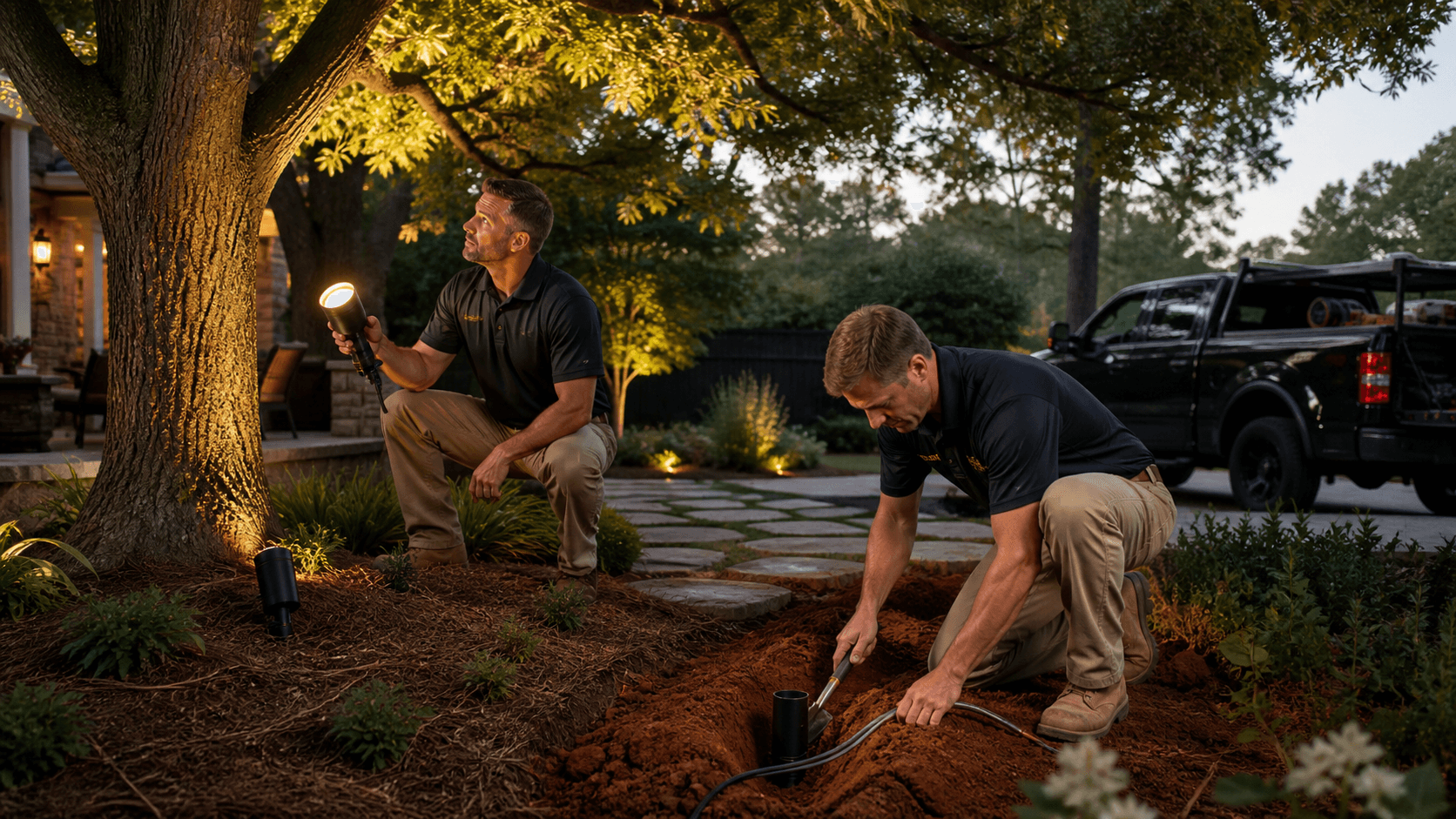
If a light is just "pushed into the dirt," clay movement can tilt it, raise it, or bury it over time. We think about deeper, more stable base preparation in clay than you would in sandy or loamy soils. That can include:
- Setting fixtures on a compacted, prepared base
- Locking conduit at consistent depths
- Positioning junctions where soil movement is less aggressive
Drainage is another piece. Poor surface drainage around beds, walls, and footings can let water sit around fixtures. In clay, that water doesn't percolate away quickly. Long-term, that can lead to corrosion and unreliable connections. That's why grading, trench depth, and clean backfill materials matter just as much as fixture choice.
Tying Lighting Into Hardscape, Grading, and Roots
Landscape lighting in Birmingham works best when it's planned with the hardscape and grading, not bolted on after the fact. Step lights, wall lights, and path lights perform better, look cleaner, and last longer when they're designed right alongside:
- Patios and walks
- Pool decks and sitting areas
- Retaining walls and seat walls
Trying to drill in fixtures later often means visible wires, weaker mounting, and cut corners around drainage and root zones.
Elevation changes are another safety point. On our hills, even a simple set of steps between a patio and a lawn can become a trip risk at night. We tie lighting into:
- Riser heights and tread depths
- Landings and turn points
- Transitions between hardscape and turf
Wiring routes have to respect both clay and trees. Conduit that cuts across main roots or sits in a low clay pocket is asking for future trouble. We plan routes to:
- Avoid primary root flares
- Cross roots with careful boring instead of cutting
- Stay deep and protected where clay may heave or settle
Your trees are long-term assets, so the lighting system has to work around them, not fight them.
Designing For Growth and Seasonal Change
Roots, trunks, and canopy growth aren't static. A good lighting plan in Birmingham looks at what a tree will be in five to ten years, not just what it is today. That affects:
- How far fixtures sit from the trunk
- What beam spread we use knowing foliage will thicken
- Where we leave access for service and adjustments
We respect root zones and avoid choking major roots with conduit or bases. When we have to cross roots, boring under them protects both the tree and the wiring.
To create depth instead of glare, we often combine:
- Uplighting from the base of a trunk to reveal form and bark
- Cross-lighting from two angles to show structure without harsh shadows
- Backlighting behind a tree or screen planting to outline shapes against darkness
Large oaks, tall pines, and crepe myrtles common in this area each respond differently to light. A pine might need tighter beams reaching higher, while a crepe myrtle can glow with softer, wider spread aimed into its branching pattern.
Seasons change the equation again. In summer, dense foliage and humid air can absorb and diffuse light. If lumen levels aren't tuned, fixtures can turn into hazy blobs with very little useful spread. In winter, when deciduous trees drop leaves, those same fixtures can suddenly feel harsh and glaring against bare branches and open views.
On top of that, heavy summer storms, saturated clay, and wind through the canopy can:
- Shift fixture angles and aim points
- Move soil around bases and trench lines
- Test every connection and enclosure in the system
That's why we lean on an engineering-first approach, treating each light, wire run, and junction like part of a structural build. When the trees move, the clay moves, and the weather hits hard, the system should still do its job and keep your property comfortable and readable at night.
Get Started With Your Project Today
If you are ready to transform your outdoor space into a welcoming, functional extension of your home, our team is here to help. Explore how our custom landscape lighting in Birmingham can highlight your architecture, improve safety, and extend your time outside. At Wood-Palmer Outdoor Creations, we work closely with you to design and install a solution that fits your property and your goals. Ready to talk about your property? Give us a call at (205) 305-7780, email our team, or send us a message.